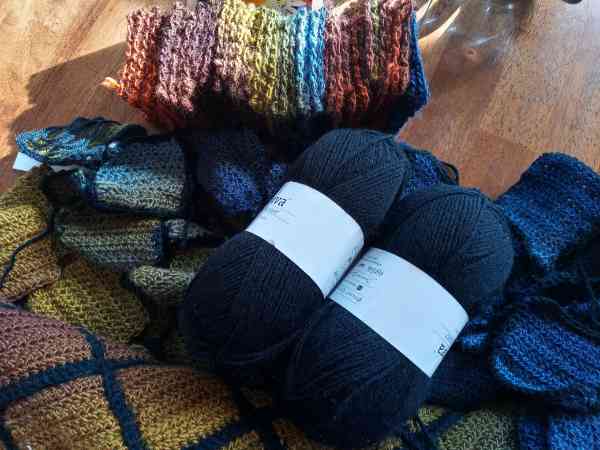
Witness me! I purchased only the yarn I need to finish a sweater and did not fill up my cart to get “free” shipping like a well-trained little consumer. Even with $6 S&H and 10% sales tax, the total squeaked in just under $20. Maybe all these squares will actually be a sweater by next winter.[efn_note]This sweater has already seen two winters in pieces, thanks to large obligatory projects, change of design plans, and not having enough yarn to execute the changed design plan. Its time has come.[/efn_note]
In other news, it was brought to my attention that most of the links on the Books page pointing to the genre pages hadn’t been updated since their parent page was named something else, so they were bad and redirected to the home page. Those should all lead where they’re supposed to now. Sorry to everyone who encountered my mess.[efn_note]Website maintenance is the pits. More so when I remember it’s a job people get paid to do, yet it’s on my long list of Labor I Perform for Free.[/efn_note]
There’s this fun residual abuse thing that makes me obsessed with accuracy, so that when I’m inevitably berated for being wrong and stupid, I’ll know it’s bullshit because FACTS are on my side.[efn_note]This absolutely does not make an abuser back down, but you can build a mental fortress on the bedrock of “you can still hurt me physically, but I know what you are and I. WILL. NOT. YIELD.”[/efn_note] So I spend lots of time researching and double-checking things like how far a horse can humanely travel with a rider in a day, what about on this kind of terrain, does that apply to a horse bred for looks and racing or one bred for work, would the rider even have the endurance to match, what’s the distance between these two real places for scale, and damn, that’s actually really far and would take 17 days one way at a reasonable pace and 34 round trip, which is an awfully long time to sustain motivation for a task that isn’t anticipated to be life-changing. [efn_note]Most New Year’s resolutions that you can do in your own home don’t survive January, so get out of here with that “month-plus in the saddle at the tail end of winter to find out what that shady guy wanted when I brushed him off in that now-distant land” nonsense.[/efn_note]
Bear in mind (because I certainly can’t) that this pertains to a place that doesn’t exist, nobody can fact check the distances or dates, and if that sort of nitpicking is taking place, the story has failed to engage the reader in any other way and therefore accusations that I’m wrong and stupid in regard to imaginary travel are the least of my problems.
While performing this psychoanalysis, I asked myself when was the last time I—preoccupied as I am with the subject—paid any attention at all to the travel time and distance in any published book.[efn_note]I do notice brazen equine performance impossibilities. No, that stallion did not gallop nonstop from dusk to dawn unless it carried on as a ghost after dropping dead or possibly during certain parts of the year near the planetary poles, either of which would have to be supported in the text, not left to the reader to infer.[/efn_note] Oddly enough, I was unable to think of an occasion. I flipped through a bunch of books to make sure it’s not mere forgetfulness at work, and most of them, in fact, don’t specify the distance or the time necessary to traverse it. The characters simply leave a place, the story resumes when they arrive at their destination, and “when they arrived at their destination” is sufficient information for the purpose of storytelling!
I had a feral notion that I too might dare to be so vague. With no specific detail there, there’s nothing to “fact” check. “But how long did it take to get there?!” *shrug* As long as it took.
I resolved to remove that clearly unnecessary specificity from the text. Anyone who cares deeply about it can consult the date at the beginning of each chapter. I was giddy with freedom!
Then, obviously lightheaded from the lack of oxygen up in the freedomsphere, I thought what if… I got rid of the dates, too?[efn_note]At this point, I had an out-of-body experience from all that exhilaration.[/efn_note]
Doing so would free me not only from specificity but also from the chapter = day imposition that has meant some scenes that end on what feels like a hard division have gotten only a soft skip over a scene break, diluting the dun-dun-DUUUUN moment.
So I took the leap. Seeing the void where the dates once were is still setting off acute anxiety, but that may be my typical irrational response to change rather than a warning I’m creating new and bigger problems. Time will tell.[efn_note]*slaps the hood of the previous draft* I can undo so many regrets with this baby![/efn_note]
In less traumatic revision news, many other cuts are much easier. In my rough and first revision drafts, I pack in as much information as I can think of to make sure I don’t overlook anything. Now is the time to stop being entirely self-indulgent and move the reader experience front and center. Viewed through that lens, a lot of that precious information is redundant or outright unnecessary. A little bit of embellishment can stay, but not where it bogs down the pace. If I’m reading a page and feel tempted to skip to the next bit of dialogue, I need to take a hard look at the part that’s boring me. There’s a small chance it can be styled into something more interesting, but mostly what it needs is a trim.
If it feels clunky, get rid of it. If there’s a noticeable hole on the next read-through, I can always plug it back in, but I’m confident anything I declare junk at this point really is junk.
In the same vein, I made a secondary character go off on a tangent that’s a worldbuilding infodump. The mention of this place probably should remain to prime the pump for when it comes up two scenes later, but when Heroine tells this guy to get some sleep because he’s talking nonsense, that should be the end of this conversation. She doesn’t want to listen to it, and he has no motivation to passionately defend his thesis, so there’s no logic in keeping it here. In this case, I did cut and paste to the end of the draft to see if any of it works in the forthcoming encounter. It might land better coming from another character who does have a reason to passionately defend his thesis, but I’m open to experimenting with how little of it is actually necessary.[efn_note]Like many writers, I suffer from Know-It-All-itis, which compels me to spread it around regardless of the detriment to the story. We first attempt aggressive containment measures and then move on to killing it with fire.[/efn_note]
I had a fantastic paragraph about the practicalities of operating a small business as a freelance assassin (specifically, ensuring adequate compensation when the majority of one’s customers are, shall we say, shady), and though it flowed smoothly from the stimulus, no amount of tinkering would make it blend with Heroine’s necessary outward response to that stimulus. It’ll be an interesting bit of trivia in the series bible, but it was clutter in the story, so it too got the chop.
Heroine went into one of these scenes with a goal, got some bad news about pursuing it, and thought about the bad news (it’s plot relevant so deserved the space), but the conversation moved on before she reacted to her original goal being moved out of reach. Failure to close little loops like that makes a scene vaguely disjointed, and it’s hard to spot where it went slightly wrong. Three pages later, I grumbled, “She got over that in a hurry, didn’t she?” I had to go back and find the place her grumbling belonged and then feather in the germination of her revised plan. Two sentences smoothed the flaw.
In the category of Doing Too Much, I described at length the one circumstance under which a secondary character detours from his fastidious habits. He’s in only two scenes in this book. In neither scene is his deviation from fastidiousness a plot point. It would, in fact, better serve his characterization in the future if readers believe his fastidiousness is an immutable property until something in his own story provokes contrary behavior. I tidied up my text to keep him tidy.
I remain very sad that puns aren’t an option when “translating” a fantasy language into English. (Or any language into any other language, obviously, but this is the tragedy I’m facing at the moment.)
Also catching occasional sneaky filter words like “Heroine interpreted that phrasing as [whatever]” and replacing with things like “That phrasing meant [whatever].” First of all, she’s the only POV character, so everything is her interpretation. Second of all, “well, my interpretation is that blah blah” is wishy-washy. It’s putting on spectacles as a disguise for “in my opinion.” The whole point of this particular exchange is that she recognizes bullshit when she hears it. There is NO possibility the phrasing under scrutiny was made in good faith, so at no point in her thought process would it be open to “interpretation.” Save “interpret” for times when the character must concede there’s an alternative. If something is fact (or believed with unshakable conviction to be), state it as such.
Fiddly things like changing “There was nothing hidden” to “Nothing was hidden” and “Not a good one” to “A poor one.” Not a dealbreaker, but when something’s easy to tighten up, why not get it over with so there’s one less debate during copyediting?[efn_note]My last drafts are pretty clean. When copyeditors/proofreaders don’t have to fix basic spelling and punctuation errors every other word, their time is free to ferociously nitpick sloppy little things that might otherwise be dismissed as “style.” I recommend giving them that opportunity.[/efn_note]
I sometimes stumble across unintentional foreshadowing that amuses me. This one made me say, “You are a MONSTER.” No one will remember this throwaway line halfway through the book, but it will be a gut punch on re-read, when you know what’s coming.[efn_note]I’m leaving it. It’s supposed to hurt. Also, I’m a monster.[/efn_note]
Sometimes improvement is simply a matter of shuffling the same sentences into a different order.
Before:
The wanderer had made his camp outside Grimtol, on a raised hump of land the locals had given a name that loosely translated to ‘tangua table.’ The big cats avoided towns as if they had a collective memory of large human herds being deadly. This spot was far enough from the herd that any rescuers racing across the marsh could watch the slaughter in its entirety.
After:
A raised hump of land outside Grimtol had been given a name that loosely translated to ‘tangua table.’ The big cats avoided towns as though they had a collective memory of large human herds being deadly, but this spot was far enough removed that one might enjoy a hearty meal in the time it took rescuers to cross the marsh in order to interrupt.
The wanderer had made his camp on it.
All the same information, but this builds to “omg this dumbass” more pleasingly.
I changed Hero’s name. Again.[efn_note]I think this is only his third name, so he’s had it easy compared to Heroine, who had at least six before the current one (which was derived from Hero’s original name) stuck.[/efn_note] One less name ending in “n”! Since his was the most frequently used (other than Heroine’s), that might sufficiently reduce the perception of samey-same so I don’t have to go through this again. I need to run a page through text-to-speech to see if its pronunciation guess is embarrassing[efn_note]À la my super scary villain named “raccoon.”[/efn_note], but since I wasn’t in love with his previous handle, it otherwise shouldn’t be a difficult adjustment.
I’m gleefully using colons in honor of people who have deeply held prejudices against numerous types of punctuation. Twice on the same page might be a little excessive, but they’re welcome to live here for now, invite their friends over, and have a double-dot rave. “You’re not allowed to use punctuation introduced to second graders because I, an adult who should definitely be taken seriously, can’t take 30 seconds to learn forever how to process it when I read” is intellectually lazy, and to declare every writer must accommodate that… whew.
I love a “possession of the possessor” construction, which isn’t inherently problematic until one uses it to the exclusion of “the possessor’s possession.” If the sentence feels cluttered and/or I used the “of the” version referring to the same thing in the recent past, the unnecessary prepositional phrase needs to go. (“Edge of the fire” vs. “the fire’s edge” prompted this mention.)
I had a great and terrible “WHAT IF” about the next book.[efn_note]No big deal, just the real identity of its heroine and sole POV character. Hardly affects the story at all…[/efn_note] I’m obviously in no rush to make decisions about that, but deviating from the current plan will have some minor effects near the end of this book, so that goes in a little pot on the back burner and will need to be sampled occasionally to see what sort of flavor is developing.
The last scene in this section feels like it’s a page too long, but I’m going to make a note about this draggy bit and attack it on the next pass. I’ve stared at it a long time without even a hint of a solution, which suggests the problem is rooted elsewhere. Since it’s just pace, not plot, it isn’t worth getting stuck here.[efn_note]The solution to “I’ve been staring at this with no movement for X days” is, in my experience, never “keep staring at it for Y more days.” I’ve tested that method thousands of times, for science.[/efn_note]
In the next big scene, Heroine is going to use a strategic hesitation: she wants someone to know she has doubts but is overcoming them at great personal expense to bestow the generous gift of her trust. In the current scene, she demands something from Hero, and he hesitates before complying. The way I cackled while skipping to that future scene to see if I could borrow any of Heroine’s behavior to suggest Hero’s doing the same thing…[efn_note]I could not! But now I know it’s a possibility, and if she could catch him doing it later? What a clever little pickle I’d be.[/efn_note]
I found a way to add worldbuilding and light foreshadowing to the description of a small object, which I’m also pretty chuffed about. Visual description does nothing for me (thanks, aphantasia!), so being able to inject it with purpose is much more satisfying than assigning a meaningless-to-me decorative attribute.
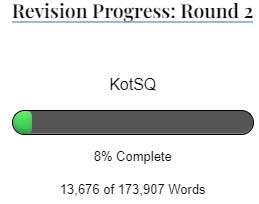
On that note, at this moment, my feeling toward this book is “reasonably pleased,” which is a good place to be during a second revision. That will change later when I collide with more material added during the first revision and (shudder) when I have to add new material on this pass, but the relative ease now gives me faith it will all get up to the “reasonably pleased” level eventually.