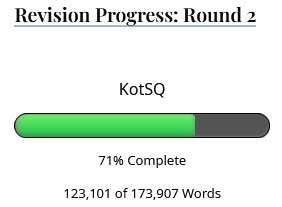
 I still imagine that when I get to 75% of this revision pass, I’ll feel like the end is in sight.
*plugs latest numbers into progress bar*
I’m never going to see 75%, am I?
Previously on Revision and Order, I sanded the edges of the big plot event I’d moved forward. Now I get to deal with the gopher holes (since Heroine and Hero no longer have to discuss and plan that event) and the massive craters (since the two days preceding that event went bye-bye) in the wake of the shift.
I removed a few paragraphs of assassin backstory. I remember adding a bunch of such passages in response to “discourse,” but like much “discourse,” it putrefies when no longer hot and fresh. Do you remember what you did at your job on the third Tuesday of the ninth month 12 years ago? I don’t! I know people with much more exciting and interesting jobs than I will ever have who don’t consider their day-to-day work activities memorable enough to spontaneously reminisce about.
You know a fictional character has experience in some area not because the author tells you about things they did in the past but because you see them behaving, during the course of the story, as if they know what they’re doing.¹ Heroine demonstrates her skills through on-page tests. Their acquisition needs no explanation.
Plus, this particular murderous backstory was me, the author, taking a jab at somebody I, the author, don’t like. As satisfying as that may be in the moment, it rarely serves the story and should be chopped.
I reached the point where Heroine puts her arms around traumatized Hero for comfort. This triggered a flashback to every editor who ever told me to make similar scenes “sexier.”
No.²
I installed much-needed support beams between a vague unease and the realization of its cause. In the first draft, I planted a findable clue, but when I reached the opportunity to find the clue, I wrote a two-sentence summary of an uneventful activity between more significant events. The two-sentence summary survived the previous round of revision.
Now it has its own brief scene, in which the clue is found. Then Heroine gets to walk around with the clue in her hand until the existing “oh shit” revelation. Not a massive change, but a world of difference in the flow of logic.
That scene was kind of flat from Heroine’s POV, so it became one of Hero’s spotlights. He has witnessed (and feels responsible for) much more gruesome deaths. Identifying why this one hits him hard provides the motivation why he does something (already written) for other victims later.
This was a good structural addition! I hate writing new material at this stage, but it stings less when the story unambiguously benefits.
In nitpick news, I wondered whether a thing that has been robbed of color by exposure to sunlight should be “sunbleached” or “sun-bleached.” Merriam-Webster includes neither but does list “sunblasted” and “sun-drenched” in the Try Again suggestions. Since we have both “sunverbed” and “sun-verbed” precedence, we can justify going with personal preference.³
In other nitpick news, I wrote “hefted the scant bundle.” I was thinking of the motion associated with raising something already in one’s arms, but upon further consideration, “hefted” seemed to demand greater weight. A quick dictionary check confirmed my suspicion. We downgrade to a more utilitarian verb for the sake of accuracy.
Part of me knows these nits don’t matter.[efn_note]I’m following a read-along of a hugely successful YA fantasy romance that unequivocally demonstrates there’s no penalty for words being MEANINGLESS.[/efn_note] Thoughtful word choice is not going to put money in my bank account. It does, in fact, impair my earning potential; if I had used all the time I’ve spent working on this book to barf a novella per month into KU, even people reading 5 pages and bouncing would have generated more income than this unpublished book.
But I’ve been doing this since 1996. I’ve made both poverty wages and a 6-figure deal that was supposed to be “life-changing.”4 I know I don’t suck because 100% of my income for the past decade has come from writing for other people who wouldn’t pay me if doing so wasn’t profitable for them. I’ve done a great deal of thinking about what’s holding me back and know which factors I own and which are out of my hands. I know at this point the pleasant dream where I write whatever I want and that earns enough to support my modest lifestyle will not come to pass. I’ve determined the point at which it will be a clear waste of time to bother with publishing and where I will write purely for my own enjoyment with none of the stress about making the product fit for public consumption.
The only dream left is writing something I don’t hate, that doesn’t embarrass me, that isn’t a lengthy series of “compromises” that turn my own work into something I wouldn’t read. It won’t be “perfect,” but if a hyphen bothers me now, if a verb doesn’t feel right to me now, dismissing my dissatisfaction as unimportant is sabotaging the one thing I’m trying to achieve.
The nits matter to me.
 ¹ Often, in fact, competence backstory is a veneer applied to in-story incompetence. Pay no mind to the super elite badass acting like a noob because IN THE PAST they did a clever thing, which you will hear about only in summary so the author doesn’t have to write that cleverness. *jazz hands*
² In the Korean rom-com Spellbound (2011), the female lead Can See Dead People after a near-death experience. The male lead is in shock after his first experience with a ghost, and she’s trying to coach him through recovery. Nothing’s working, so she breaks out the big one: “Accept comfort!” with her arms open wide for a hug. I burst into tears in part because I was certain they were going to ruin everything with a makeout session. (They did not, and it’s now on my short list of Rom-Coms I Don’t Hate.)
³ I imagine the difference in this particular case is that the reader’s eye might conclude “sundry” or “sundered” based on the initial character string and move on, only to crash into a wall of conflicting context, whereas all the dictionary entries beginning with “sunb” are clearly “sun + other word.” When grammatical “rules” appear inconsistent, it’s most often in service to clarity. Memorizable rules are a yardstick to measure judgment against, not a replacement for judgment.
<sup>4</sup> And it was, just in a Monkey’s Paw kind of way.