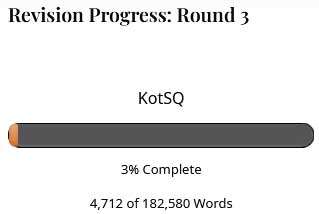
 Tracking for the third round of revision will be same as the last. The target is the final word count of the previous draft (182,580). Progress will be measured by how many words of that are removed with transfer of revised scenes to the new draft.
Since it has been opined this method is dottier than a pointillist leopard, imagine the previous draft is a cookie. We take bites until it’s 100% gone, no more, no less.
If I set an arbitrary target like a manager happy to sacrifice quality so the spreadsheet meets expectations, it would stress me out, and I don’t get paid enough to work under those conditions.
I consult a thesaurus mostly for tip-of-the-tongue words—when I know there’s a specific word for what I mean, but my brain is in malicious compliance mode, offering every possible option except the one I want. I can’t spit it out, but I’ll know it when I see it.
Be that way, Brain, but I better not hear any crying when you find me in the comforting arms of Merriam-Webster.
I say this about thesaurus use often, but I never have an example ready. UNTIL NOW.
Keep three things in mind when playing games with dragons.
First of all, “keep in mind” doesn’t sound like something this character would say. Imagine Jeremy Irons wearily drawling “eep.” It’s just silly. “Bear in mind” sounds more in character but leaves me with the second problem.
“Thing” is a word that should be in every copy editing workflow because it’s vague to the point of meaningless. The vast majority of the time, “thing” can and should be replaced with the specific noun(s) hiding behind it.
The three “things” that follow the above sentence are delivered much as rules would be, but the character doesn’t fancy himself a boss and doesn’t expect to be heeded, so he wouldn’t call them rules. Recommendations? Appropriate “I’m not the boss of you” stance but too timid. The character isn’t without authority. He fully believes he should be heeded. Time to consult the thesaurus!
Which quickly supplies COUNSEL. Perfect! It’s superior, implying “in my many decades of study and personal experience with this matter about which you know nothing,” yet not in a position to force compliance. This character would absolutely use “counsel.”
“Three counsels” doesn’t make sense, but the right word provides a focal point around which to recast the sentence.
My counsel regarding playing games with dragons comes in three parts.
With that first sentence and a little shuffling of the last, I have a 251-word prologue/framing device I’m happy with. Off to a great start!
If I don’t look directly at the intimidation of having to live up to such a great start, maybe it will lose interest and go away.
I read the first scene aloud for one of my speech therapy sessions. Rather than torment myself with the segment of the terrible ballad therein, I substituted the last song I heard, which was “…Baby One More Time” by Britney Spears. Undesirable in different ways, but it did make me think about what sort of songs I, very much not a singer, will sing with gusto.
For exhibits A and B, I give you Spongebob’s “The Campfire Song Song.” and Lubalin’s 48-second broccoli casserole soap opera. Because when this childhood overachiever does something she can’t do well, she leans into playing the fool so looking silly seems intentional!
Well, I can’t write serious lyrics either, so is not the obvious solution writing deeply unserious lyrics?
Accordingly, readers will now be treated to a bawdy saloon song that inquires of the singer’s mama why it’s said the heroic prince was hung when everyone knows he was burned at the stake. Same story the terrible ballad set out to tell, now with no respect whatsoever, consistent with Heroine’s attitude toward legendary heroes.
Took two minutes to write a stanza I’m happy with. Silliness for the win.
The first scene is tidy enough that I can nitpick a little prematurely.
[The horse] had a tendency to bolt at every loud noise and sudden movement.
It may be “true” that the horse generally, often but not always, noped out upon being startled. As we know from therapy, we mustn’t say someone “always” or “never” does something because surely there are exceptions for which they deserve credit. It’s only fair to soft-pedal the frequency of an offense.
This is a story that exists only in my own head. No one can fact check the accuracy of my reporting. I am the sole authority on this fictional horse’s behavior. Weasel words are not required.
[The horse] bolted at every loud noise and sudden movement.
Delete the wishy-washy words and what’s left sounds like it was written with conviction.
I started cleaning up worldbuilding artifacts that I know are covered later, irrelevant, redundant, or can be better expressed. For example, a lengthy “everybody knows” sentence about avoiding magical beings or at least not pissing them off can be applied, in story time, to an interaction with a magical being.
“I’d give it to you and good riddance,” she said through a conciliatory smile, “if you wouldn’t set my hair afire after it breaks your ghastly little teeth.”
Rather than telling you magical beings are unfriendly, I show you Heroine performing the threat assessment and responding accordingly.
Show, Don’t Tell! Dramatize, Don’t Summarize! Specialize, Don’t Gen’ralize!
In other, less easily misconstrued words: Whenever possible, find ways for characters to act out information you want the audience to have, and then delete the parts where that information is written like bullet points in a slide presentation.
Scene 2 won a contest a million years ago, so it’s obviously flawless as is. Moving on!
*snort*
No, that just means it’s been gone over more than any other part and nitpicking is not premature.
The sun low on the western horizon cast long shadows that enveloped Grimtol’s mudbrick buildings in the prelude to night.
What’s making those shadows, now? And it’s not the prelude to night because there are shadows; it’s the prelude to night because the sun is setting. Yeah, I understand what I was getting at, but it’s just lying there like something you don’t want to step in.
The sun low on the western horizon lit Grimtol so its squat mudbrick buildings cast shadows long as palace towers.
Behold, the sun is lighting and the buildings are casting deceptively impressive shadows.
And, as an accidentally clever bonus noted while typing this post rather than while editing the actual book, it is a shadow palace, and Heroine is known a the shadow queen. Nice job, Brain.
The second scene used to be the first scene, which means it had some introduction that is now handled in the current first scene. Snip, snip.
Also, when this part ventured out into the world previously as a contest entry, I succumbed to pressure to shovel description all over it. I can see now most of it has no relevance and doesn’t even need to be replaced with different description. We’re not coming back to this location! We don’t have to form an intimate relationship with it so we can track how it grows and changes. Note the vibes, do our business, and get out.
This scene ended up 200 words shorter than previously and is better for the shrinkage.