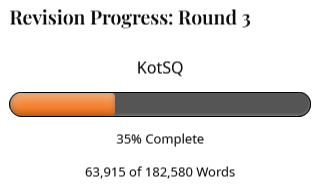
 This week on Revision Island, we get back to deeper work than changing or rearranging a smattering of words. The need was obvious, so maybe (fingers crossed) the tweak-only portions really were mostly fine.
Heroine has never trusted Hero because he lies like a rug on the floor, but—as noted in the text—hers is a shady business in which clients seldom give her the whole truth, so dishonesty isn’t a deal breaker up until the point his lies cause her harm. Ah, smell the foreshadowing! In order to develop rather than spring that, I had to play up a truth she stumbles across being potentially very bad news for her, thus tugging her thread of paranoia that everything in her life right now is a vast conspiracy with her old boss pulling the strings.
We’ve been preoccupied with Hero’s curse problem for the last little bit. I don’t want you to forget Heroine’s fugitive status by removing all thought of it just because she has a job to do for him. Thirty-six hours of preoccupation while exploring an extraordinary situation? Fine. En route to the place she expects to be in maximum personal danger? It’s going to be at or near the front of her mind.
In a post-disaster scene, Heroine’s emotional reaction felt off. The Laban efforts are proving to have the most utility for me in those cases. Her default is Jab (or, thematically, Stab). I think of it as four switches, in this case set to Direct, Quick, Light, and Bound. With a mood change, I can temporarily flip any one of those switches out of the default. Any more than that and it becomes an unrecognizable personality that leads to “WHY ARE YOU ACTING LIKE THIS?”
So what primary emotion is affecting her? She’s shaken, by both a revelation and another brush with death, and she absolutely, under no circumstances, wants to show that weakness to Hero. She wants to project maximum stability—so we flick the Light switch to Heavy and leave the rest alone. Direct, Quick, Heavy, and Bound corresponds, suggestively, with Punch. She’s not going to strike him with her fists, but she can strike with her words, quick and cutting by default, now blunt and forceful and meant to stun so he’s too busy trying to keep his balance to notice how wobbly she is.
Works much better than flying off in every direction as if characters lose all sense of self under duress.
Full disclosure: There’s a school of thought that says “let your characters be unrecognizable, people are random and unpredictable.”
This thought had to start its own school because most behavioral science comes down on the side that people are creatures of habit and, particularly if you know an individual well, entirely predictable, which is why they’re so manipulable in ways great and small, for good and ill. (And why so many Cassandras have to resist the urge to make “Before you leave a message, ask yourself if I fucking told you so” their voicemail greeting.)
Writers should know their characters, and they should introduce them so that readers know them, as well. When they do something outside their norm, readers should be shocked-but-not-surprised because that act was clearly within the realm of possibility, not a random, inexplicable departure from all prior characterization.
“People are random and unpredictable” generally translates to “I wasn’t paying attention,” and when the people in question are products of your own imagination, that’s worrisome in ways that surpass real-life inattention to humanity.
Hey, I’m not your boss! I can in no way impede your pursuit of random whims. I’m just throwing it out there that if your stories lack internal logic, readers are going to hurt your feelings.
Before: The gears were stiff with centuries of dirt and rust.
After: Centuries of dirt and rust stiffened the gears.
Again, getting rid of lifeless, overused “were” and tightening by 2 words in the process. Is it life-changing? No! And I could make an argument that the new subject of the sentence is worse than the old. But on the whole, it’s more polished than The gears were stiff. The tunnel was dark. More stuff was passively existing in a state.
I DNF books all the time because the authors clearly didn’t give a damn at the sentence level. Today, I refused to spend 99 cents on one because, shortly after I resolved not to be harsh about the 4 was-es in the opening paragraph, the author slapped my face with another paragraph in which someone was walking, which was unusual, it wasn’t a large town, and she was pretty sure. Why would I subject my own book to behavior that makes books unreadable to me?
Tiny improvements nonetheless improve.
“Why don’t you just skip all the weres and wases in the first place?”
Because they’re low-effort. Drafting a novel consumes an enormous amount of mental energy, and depending on how many other demands are simultaneously draining that limited resource, there might not be enough to cover dazzling prose during the construction phase. By all means, whip out the uninspired fallback verbs to get the idea on the page and finish the damn draft.
If you don’t blog about it like a chump, nobody will ever know the book didn’t spring forth in its sparkly final form.
The key thing, though, is getting rid of the worst offenders during revision. If you can’t be bothered with easy changes such as “was vigorously stirring” to “vigorously stirred,” I’m incapable of believing any more substantive work was done before rushing to publish.
Hey, I’m not your boss! I can in no way impede your wholehearted embrace of uninspired fallback verbs. I’m just throwing it out there that I, for one, refuse to read books that make me feel like an unpaid copyeditor.
Another scene felt off. Heroine acquires an item that will be necessary a few scenes down the road, but otherwise it near-repeats two things that have already been written and gets weirdly lecture-y.
We need that acquisition, though.
When all else fails, resort to the ol’ POV shift. (Ahaha, look at me already breaking the “pattern” I hoped to maintain 2 updates ago. Oh well. That’s how it goes.) Now we can have Hero supply fresh examples from his own experience that support Heroine’s points. We can get his reaction to her points. We can get into his dismay that she’s right and he doesn’t find her as objectionable as he hoped he would before they met and he dragged her into this hazardous situation and her life has been endangered 4 times before they even get to the dangerous part. When she gets preachy, he can feel lectured and be ashamed of being a judgmental ass and worry about how to make things right.
It gives me a lot more to work with, even using the same touchpoints from the original scene.
“Heroine’s POV Only” was something I thumped my fist about in 2018 due to public events during which I finally surpassed my lifetime limit of being subjected to the perspective of worthless men. Cut their mics, turn off the cameras, don’t reward them with attention for tantruming like toddlers when denied the toys to which they feel divinely entitled. I couldn’t stop the media from tirelessly uplifting these whiny pissbabies, but I could refuse to yield the time of a woman doing the work like an adult where I did control the narrative.
This fictional man has since proven his value, so now he’s allowed the floor when he has something uniquely useful to contribute—about 7% of the time.
The end of this batch kind of drags. My gut tells me 3 scenes need to be compressed into 2, and not by simply removing a scene break. Some substance has to go in the name of pace.
This is where we take the word processor’s highlighter, black out components of the scene, and give it a read without. Does the lack cause chest pain, cold sweat, and palpitations? Probably should keep that part. Otherwise, move it elsewhere, or is it safe to trash? Because everything is built on a foundation, how far back do we have to go to remove the supports underlying the trash?
I think Hero’s apology, despite being a good one, is the most disposable element. Tossing it means going back and not letting him be a jerk who owes her an apology. Make his questions more curiosity than interrogation? If he’s not a jerk, Heroine can’t get defensive and there’s less or no stimulus for a lot of her subsequent self-reflection, so what happens to that? Is that self-reflection even in character, or is it an authorial defense mechanism to justify choices to people who would probably never pick up this book and certainly wouldn’t get 35% into it if they did? Ugh, now I have to self-reflect.
After more black bars and move-or-trash choices, I did get it down to 2 scenes, shorter, and the pace does feel better. I’ll check the wounds in a week or two to see if they’re healing, but I can’t make a prognosis in the midst of this carnage. I won’t be surprised if it needs another procedure.
I bet it’s a relationship arc problem because it’s always a relationship arc problem in relationships that have recently formed because forming new relationships is the worst and nobody should ever do that. Surely I’ve learned how to overcome this (in books) by now. I’ll just map the arc, the discrepancy with this screwy spot will become obvious, and I’ll beat it with a hammer until it conforms to the arc’s shape. Easy! (LOL no, it’s a disaster. Tears fell. Half the “fixes” were notes for Future Me to deal with because Present Me shrank from the task.)
I did quickly notice that I failed to root Hero’s new POV scene by calling up past events and his prevailing mental state, though, so some good came of the exercise.
*deep breath* IT DOESN’T HAVE TO BE PERFECT RIGHT NOW, ONLY BETTER.