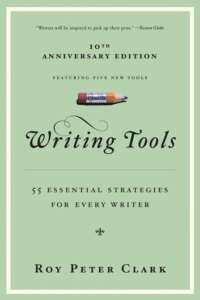
I refer to Writing Tools: 50 Essential Strategies for Every Writer by Roy Peter Clark as “the sentence-writing book,” though the scope does expand after the first section, ending with general career advice. I’ve gifted dozens of copies and recommended it to every writer I know, whether they’re writing school papers, blog posts, business emails, news copy, memoir, or fiction. Regardless of what you write, the tools in this book can help refine it at the sentence level.
Like all writing guides I recommend, this one has a “tools, not rules” approach. The same way you wouldn’t employ a hammer for every task, any one writing tool isn’t appropriate to use on every sentence. The chapter headings read like mandates, but the chapters’ contents elaborate on why and when to use that tool—and why and when you shouldn’t. For instance, the first chapter, “Begin sentences with subjects and verbs,” deals with right-branching sentences with the subject and verb at or near the beginning and subordinate elements unfurling after. Clark provides some good examples of this, an example that demonstrates the hazards of inserting a blockade of words between the subject and verb, and an example of delaying the subject and verb until late in the sentence for the purpose of building tension or interest—not negating the utility of the tool, merely acknowledging that a tool effective the majority of the time is not always the right tool.
Clark counters prescriptive writing instructors who say “never, ever do this” (despite evidence they do it themselves on a regular basis) with “actually, this is the perfect tool under these specific circumstances.” For instance, passive voice is the correct tool when you want the focus on the recipient of the action, not the agent. Forms of “to be” are often the most natural way to connect ideas. Some adverbs are red flags calling attention to weak verbs (“went quickly” when ran, dashed, raced, flew, or any other speedy verb is available), while the worst adverbs are redundant (“shouted loudly,” when a shout is, by definition, loud). But adverbs are modifiers! If you are modifying the understanding of a word via application of an adverb (e.g., “mutely shouted” conveys the facial intensity of a shout sans volume), you’re using adverbs for their intended purpose.
There’s a chapter about what Clark calls “word territory,” by which he means unintentional repetition of words creating undesirable density. This is a pet peeve of mine, both in terms of “once per book” words (verisimilitude is a fine word on its own, not so much in a swarm) and careless repetition in close proximity (e.g., one mega-bestselling author’s “the sun topped the tops of the clouds”), so I enjoyed seeing it called out. (Don’t worry; there’s a chapter extolling the virtues of purposeful repetition later.)
The “Get the name of the dog” chapter focuses on journalists drawing a story from real details, but this is even more important in fiction when the writer dictates what’s “real.” We have the opportunity to ground readers in a time and place that exist only in our imaginations, and it’s the little details that make that imaginary realm seem lived in. A corgi named Cheddar is more vivid than a generic dog, a maple more vivid than a generic tree, meatloaf and mashed potatoes more vivid than a generic dinner. Such “unimportant” details efficiently define tone, setting, and character without announcing the effort to readers.
Incidentally, Clark quotes Chekhov in a way I haven’t seen elsewhere: “One must not put a loaded rifle on the stage if no one is thinking of firing it” (emphasis mine). This version isn’t about the prop; no one actually has to use it. The gun is a symbol of the violence within a character, foreshadowing an explosion. (Chekhov apparently gave some form of this advice frequently, so there are probably as many valid citations as invented ones. This is my favorite, authentic or not.) With my aphantasia, it’s easier for me to describe a setting I don’t “see” if the things in it have meaning, even if that meaning is such a stretch no one but me will ever be aware of it. So the clock on the wall is slow to create the illusion there’s more time than there really is, the sheep on the hillside are clumped together in solidarity the focal character lacks, a shelf full of liquor bottles suggests the resident’s intemperance even if no one is shown imbibing. Decorate the page with intent.
Clark writes in one chapter, “this tool gave me choices I did not know I had,” which I believe is the point of learning writing craft: collecting tools so you have options in any situation. You don’t have to use a tool, sometimes you shouldn’t use a tool, but once you have that tool in your tool shed and understand its functions, you can apply it when the need arises rather than bashing every problem with a rock and wondering why your writing never gets better.