I’ve been using StoryGraph for a full year, so I have book-nerd stats.
Books Read
I read 74 books and 28,075 pages in 2025.
One book was a paperback; the rest were ebooks.
Did Not Finish
DNFs aren’t included in the “books read” count, but pages read before quitting are included in pages read.
I quit 25 books in 2025, which is a quarter of the books I started. Life is too long to spend it reading books that are neither enjoyable nor enriching. Thrice I wish I had followed my own advice and dropped bad books, but in one case my outbursts were entertaining an audience and the other two I was compelled to rage-finish in order to thoroughly document the extent of my dislike. (Being a petty bitch is not self-care in the moment, but whipping out receipts if some fool wants to argue with me about trash in the future will be.)
Again, all but one were ebooks.
Average progress through a book before quitting was 39%. Two books don’t have a stopping point recorded. I quit 3 books at 6-8%, and I presume those were free. (Kobo nonsensically disables previews on free books, and if they didn’t do that, I would acquire precisely 0 books that are intolerably bad within the first 10% because I would read the sample.) I ditched 5 books at 28–33%; 6 books at 41–49%; and 6 books beyond 50%.
I have no “I must give it a chance until some fixed point” rule and reject the sunk cost fallacy. Whenever I’ve had enough, I will have no more.
Genres
Finished Books
The tally on the graph below adds up to 158, which exceeds the number of books read because the books’ secondary categories are included. (Or, in the case of The Shining Saints, quaternary categories. “Historical”? Really? I suppose romance is labeled “historical” based mostly on aesthetics, so I don’t know why I’d begrudge medieval not-romance the same privilege, other than distaste for data clutter.)
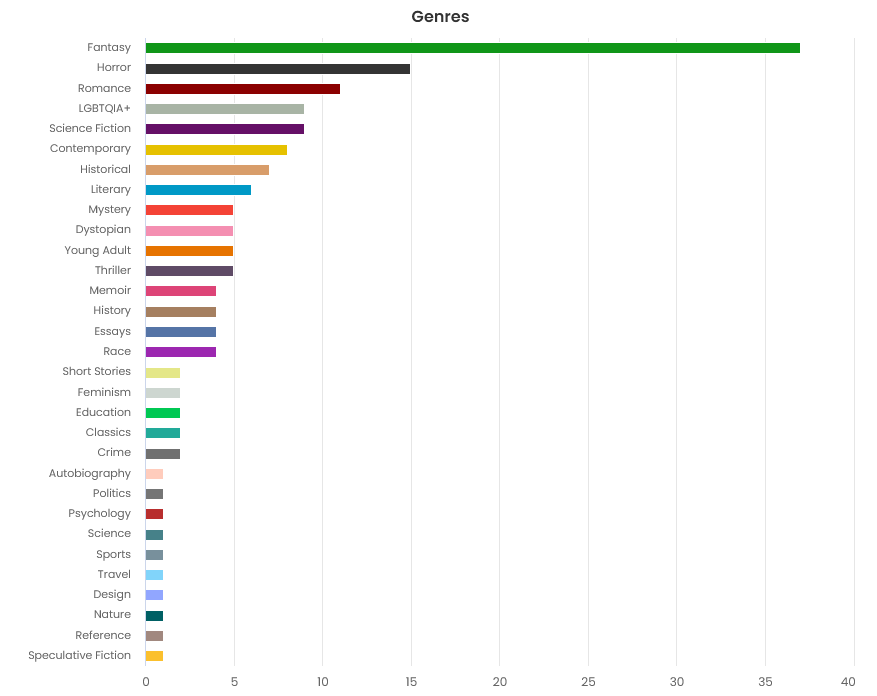
Since I like the pretty colors but the graph is hard to read: Fantasy 37, Horror 15, Romance 11, LGBTQIA+ 9, Science Fiction 9, Contemporary 8, Historical 7, Literary 6, Mystery 5, Dystopian 5, Young Adult 5, Thriller 5, Memoir 4, History 4, Essays 4, Race 4, Short Stories 2, Feminism 2, Education 2, Classics 2, Crime 2, and 1 each for Autobiography, Politics, Psychology, Science, Sports, Travel, Design, Nature, Reference, and Speculative Fiction.
Obviously, my choices this year leaned overwhelmingly toward fantasy, accounting for nearly half the books I read and 3 times more than my distant second fave, horror.
Only 6 books were double-classed under fantasy and romance. (And I dispute one of them being classified as a romance; maybe the series has romance later, but I rage-finished that book, and there was zero romance in it. And yet Water Moon, which I personally wouldn’t file under romance but definitely does have a romance in it, isn’t filed under romance. Other people’s category selection mystifies me.)
DNFs
In keeping with the fact that I’ve been choosing mostly fantasy, most of my DNFs were fantasy.
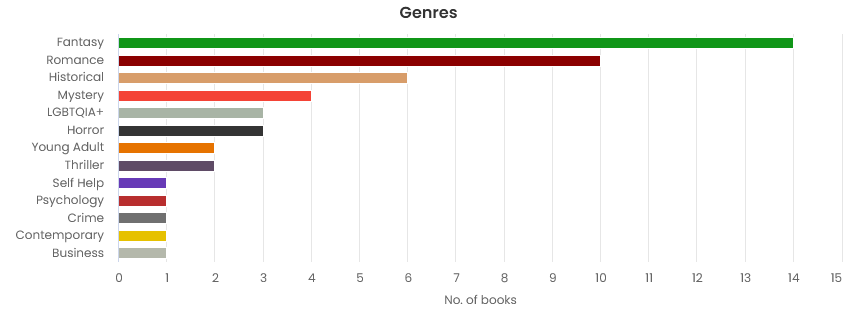 These pretty colors are a little bit easier to read, but for maximum clarity: Fantasy 14, Romance 10, Historical 6, Mystery 4, LGBTQIA+ 3, Horror 3, Young Adult 2, Thriller 2, and 1 each for Self-Help, Psychology, Crime, Contemporary, and Business.
Of the 51 fantasy novels I tried in 2025, 27% were DNFs.
I quit nearly as many romances as I finished (10 and 11, respectively). Five of the DNFs were double-classed in fantasy, again one short of the number I finished. Of the 21 romance novels I tried in 2025, 48% were DNFs.
Mysteries were 44% unfinishable. (Two of the DNFs were “must have been free” quick nopes.)
Horror had only 3 losers of 18 total books, for a 17% fail rate.
Genre Surprises
I finished all the science fiction I tried this year. I’m fussy about that genre because there are so many tropes/conventions/attitudes I want nothing to do with. Although I didn’t like several, none of them were bad enough to quit. One is even on my Best list.
I hate sports books, but I got really invested in the one I read. Probably because the quantity and variety of drama was so overwhelming, when they finally got around to sport, I needed those moments of not caring to process the preceding WTF.
Most Read Authors
Terry Pratchett and T. Kingfisher, both comfort authors, were tied at 3 books each. Octavia Butler and Micaiah Johnson each had a duology I read in full, and I read 2 standalones by Cherie Dimaline.
Biggest Disappointment
I thought throughout most of Kelly Barnhill’s When Women Were Dragons that it would be 5 stars and on the Best list. I experienced a lot of things in the book even in the Eighties. I felt seen. The rage bubble within me swelled to bursting as I read.
But then in the epilogue, decades after the story proper, the end result of 600,000 women spontaneously turning into dragons and throwing society into upheaval was women were able to have jobs and lesbians were kinda tolerated. So… like now? Hey, maybe the point of the story was that absolutely nothing women do, up to and including turning into dragons en masse, will improve their position in society! If so, point made; I just think that’s a shitty point. In a fantasy in which women’s rage spontaneously transforms them into literal dragons, I would like a fantasy ending in which that event leads to an outcome different from a timeline in which dragoning never occurred. The hopeless, dismal letdown of an ending negated all my positive feelings that came before.
The Best
Looking back, the three books I still want to talk about after getting some distance are Soon by Lois Murphy, The Space Between Worlds by Micaiah Johnson, and Water Moon by Samantha Sotto Yambao. I don’t know if I’ll do that here or YouTube. (Well, I will here, eventually. YouTube remains questionable for numerous reasons.)
Honorable mentions to The Very Secret Society of Irregular Witches by Sangu Mandanna, Dreadful by Caitlin Rozakis, A Sorceress Comes to Call by T. Kingfisher, and The Foxhole Court by Nora Sakavic, all of which I have lingering good feelings toward but no pressing urge to talk about.
Edit: I’m working on my Soon commentary now, and I think I’ve figured out the difference between wanting to talk about a book or not. Enjoyable + perfectly serviceable writing doesn’t move me to elaborate, but I can talk for days when a writing device I’ve seen fucked up so often I expect it to be bad is done flawlessly. It makes me so happy, I can’t help but gesticulate wildly and screech “Look! It can be done!” This is valuable to two people on the planet who aren’t me, but I was over the idea I’d be popular after about half a day of kindergarten, so I’M DOING IT ANYWAY.
The Worst
If we don’t count Cat’s Cradle by William W. Johnstone because I read only half, The Raven Scholar by Antonia Hodgson—one of the two books I rage-finished—wins the crown. It wasn’t the worst prose I encountered this year, but it was personally recommended to me as something I would love by so many people, none of whom I will ever take book recommendations from again. The only two things I liked conceptually were the footnotes (though they were underutilized) and Sol (whose comic relief sucked all the gravity out of the threat of apocalypse and made the gods as a group seem goofy and devoid of menace). Everything else left me marveling that this book hasn’t been ripped to shreds in hours-long rants all over Booktube, to the extent I’ve considered reading Lightlark or Age of Scorpius to find out how they could possibly be more worthy of the ridicule this book dodged.
Find me a book with footnotes on the scale of The Amulet of Samarkand (Bartimaeus was an unsurpassed asides guy), a melodramatic talking animal sidekick, and the sort of adventure that will be enhanced by those assets, and then we’ll talk.
2026 Plans and Predictions
When I set an annual reading “goal,” it’s usually 52 because for most of my life I’ve been able to comfortably read a book per week. I don’t feel good about my free time in the year ahead, so I’m going to set it at 36 to reduce my chances of “failing” at my only leisure activity.
My already-bought TBR is down to Blood Over Brighthaven by M. L. Wang, which I’m skittish about after the Raven Scholar fiasco because it was also much hyped; White Horse by Erika T. Wurth; Floating Hotel by Grace Curtis; The Warm Hands of Ghosts by Katherine Arden; and The Antiquity Affair by Lee Kelly and Jennifer Thorne.
Since I’ve had no luck with Kobo’s sample-free free books and refuse to go to another site to try before I not-buy, I’m going to stop clicking on books marked “FREE!” and spare myself some irritation.
It might be a year of re-reads and dusty old classics from Project Gutenberg, given the tightness of money. I was able to find the first 10 Pulitzer Prize winning novels on PG, so I thought it would be fun to check out what was popular among the literary set half a century before I was born. I predict I’ll finish few on the Pulitzer list because I’m a lowbrow, uneducated, genre-loving peasant and the voting body has never been, but let’s strive for an optimistic 2 out of 10.
If I want to get more paper before my eyes, my mom has shelves full of old-school romances, and I have a box of books I refused to part with when I moved 600 miles and could take only as much as I could cram inside a Corolla. I have enough to keep me busy for a year even if I DNF every available book at 39%.