 Every time I mentioned Hero’s age at the time of his traumatic childhood event in previous drafts, I wrote “ten (or twelve?).” Unable to remember if I decided one or the other earlier in this revision pass, I wasted a fair amount of time searching for that answer and debating the pros and cons of 10 versus 12. Finally, a bone-weary voice from the depths of my mind whispered:
E-le-ven.
Brb, gotta put “making insurmountable obstacles out of the most trivial bullshit” in the Skills section of my résumé.
That’s the best that can be said for that scene, unfortunately. It’s lacking necessary emotion, but since I’m living in a protective bubble of dissociation right now, I don’t have a wealth of emotion to share with it. I’ve written many books while dead inside! This one deserves better, though.
I made up a name for a famous painter so easily I’m sure there’s some real-world association that will come back to bite me in the ass. There’s a popularity threshold below which search engines won’t show alternative spellings, so another fictional character or an athlete or an up-and-coming podcast bigot could be lurking behind one mismatched letter.
I love names! *twitch*
White European culture leans toward marriage of “convenience” to legally incorporate a suitable heir into a family, but Japan, for many centuries, has had yōshi-engumi, the practice of adopting an adult to become one’s successor as head of household and business while carrying on the family name.
Since you can decide that a biological child who has carried your name since birth is unfit to fill your shoes and bestow that honor instead upon a non-relative you believe will do a better job, the endorsement seems like the truly important aspect, of which “I give you my name” is the chosen demonstration.
Some of the systems of government on Story Continent aren’t guaranteed to pass through bloodline, but it’s presumed a leader’s children were raised with the same values and would therefore lead in a similar fashion. If the parent was an excellent leader, their offspring would have an edge over both an unknown political challenger and the offspring of a despised tyrant.
Blood is irrelevant. Name is irrelevant. The training by and support of a well-regarded figure carry the social value.
I’d already decided surrogacy and adoption of young children were on the table even for royalty in Story World. Why not a process for taking on an adult heir for those who don’t want to be around small children in order to mold them? The kid’s family of origin can be responsible for education and temperament. When prospective heirs mature, they can be judged for suitability to assume control of a household/business, and the adopted heir, through both that contract and their own decisions as they take on responsibilities of their new station, would benefit their family of origin—similar to a strategic marriage but with none of the associated sexual/breeding obligations.
Which is to say: The [heir agreement] placeholder in the manuscript finally had to go. I don’t love what I came up with, but at least there’s something there to improve, and I can live with it if I have to.
This is really the round to get rid of all the placeholders. The remaining revision passes will be about smoothing, which requires a level of flow that will be destroyed if I have to stop to agonize over making up names.
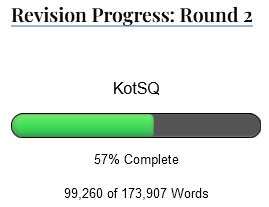
Not much progress in the more-than-a-month since the last update, but [redacted whining about personal problems]. Just not enough synapses firing at the end of most days to work on personal projects that require a functional temporal lobe.