This isn’t a Never Do This Shit post because movies are great for teaching a lot of general storytelling concepts. Many of film’s lessons about pacing, rising action, characterization, doling out exposition, the content of dialogue, and more can be directly applied to stories that are meant to be read rather than produced and watched. Since watching an entire movie takes a third or a quarter of the time it takes to read an entire novel, movies can be a more efficient delivery method for big structural lessons. If the example movie is popular enough to have entered the cultural zeitgeist, even people who haven’t watched it may know enough through osmosis to understand references. Instruction aimed at screenwriters has leveled up my non-screen writing in many ways, so I’m not dismissing the practice entirely.
This is instead a Never Do This Specific Shit post, inspired by a freelance editor’s blog post purporting to be about dialogue tags. I suspected we would have a difference of opinion because her teaser mentioned adverbs[efn_note]Bad takes about adverbs are so plentiful, I heave a weary sigh at the mere mention of the word “adverb.”[/efn_note] (“boo”) as well as attribution (“hiss”), but I didn’t even get that far before noping out because the example used for the post about dialogue tags was the movie Casablanca. Not even the screenplay, mind you, but the film itself.
In a screenplay, every line of dialogue has an attribution. The speaker’s name is always directly above the words to be spoken, printed in all caps. Often, an -ly adverb is included to clarify tone.[efn_note]Screenwriters sparingly include stage direction, as both directors and actors are rightfully touchy about having their contributions minimized through micromanagement. However, “nervously” and “haughtily” are two entirely different characters, as are “wistfully” and “in a calculating manner” or “casually” and “villainously,” so tone that needs to be carried forward is important enough to lightly step on the production team’s toes.[/efn_note] Here are some examples from the first few pages of Casablanca‘s screenplay, which probably occur within the first 5 minutes of the movie:
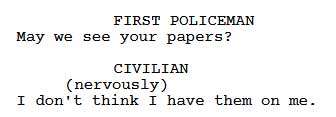
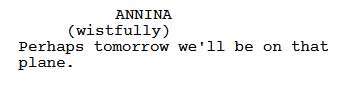
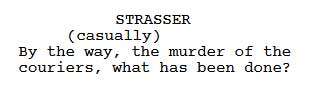
A novelist probably shouldn’t begin every passage of dialogue with “EDGAR (creepily),” so it’s clear why the screenplay wasn’t used for this “lesson.”
Okay, so let’s talk about the movie that was used instead.
One of the first remarks in the post was that Rick’s description of his establishment as a “gin joint” rather than a “resort” or a “dive bar” served as characterization through dialogue. However, “gin joint” in textual isolation does very little. We need context to position the character’s evaluation in regard to reality.
First, there’s a neon sign identifying the place as “Rick’s Café Américain.” We enter the establishment and see something that looks unlike what most of us would envision a café to be.[efn_note]The screenplay describes the place as “an expensive and chic nightclub which definitely possesses an air of sophistication and intrigue,” but the written words weren’t used for reference, so we’re talking about what we can see on film.[/efn_note] The patrons include men wearing tuxedos and women wearing sequins and jewels, among others. There’s a bar. There’s a sizable band providing live music. The waiters are wearing jackets and bow ties. Through another door, there’s a casino.
In other words, “gin joint” is a bit of an understatement, which is characteristic of Rick, who affects a mien of nonchalant boredom. However, merely uttering the words “gin joint” says very little if the audience hasn’t seen the rather lavish scope of the place.
In a movie, what you see is the work of hundreds of professionals whose names scroll by in the end credits. People choose the locations, the physical spaces that are both suitable for the scene and can accommodate a film crew. People fill that space with furniture and props and color and texture to make it look appropriate for the scene. People decide how many actors need to be in the scene and which actors are best suited to the task. People decide how each of those actors will be dressed and have their hair and makeup done. People decide what will be the camera’s focus, what will be in the frame but not the focus, and what will be left out. People decide what inflection to speak with, what facial expression to wear, what mannerisms to affect, and how to position their bodies. People decide how to use light, color, sound effects, and music to emotionally manipulate the audience.
If you’re writing a novel, you don’t have a team of hundreds making all those decisions and doing all that work for you. Everything those people do is your responsibility. You have to write words for everything they contribute to a movie, and no amount of movie watching (or even screenplay reading) is going to teach you how to fit those words into the flow of a novel.
A movie can throw one image into viewers’ eyeballs, and they will instantly understand it’s nighttime, it’s hot, they’re inside, it’s a club, specifically a fancy club, and the tone is one of good cheer. In a novel, you have to write words about the electric lights dim enough to flatter even the ugly, the vaulted ceiling, the listless rotation of the broad-bladed fans suspended from it, the booze that flows apace with the tempo of the music (you signal the band to slow it down for a fiver before the waiters drop dead), the woman at the VIP table is smoking a cigar that costs more than your car (and smells better, too), and melancholy has been struck (literally—shoes were thrown) from the band’s repertoire, for tonight the entire world is celebrating the death of Dingdawn the Witch. You can’t shove this into readers’ eyeballs like an establishing shot in a movie because people generally don’t want to read a page or two of setting at the beginning of every scene. You have to provide just enough information initially to orient the reader and then introduce more details throughout the scene to demonstrate the ongoing presence of physical space (which, in a movie, is always visible in the background).
Likewise, in a movie, you know which character is speaking because you’re looking at the actor whose lips are moving, and you know that character’s attitude because the actor (with varying degrees of influence from the director and screenwriter) uses their voice, face, and body to convey that information. If you’re writing a novel, you don’t get actors. You have to write the words that make clear who is speaking and how. Even if the content of the dialogue could clearly come from only one character (e.g., a chemist at their kindergartner’s career day is unlikely to be mistaken for one of the 5-year-olds), it may sometimes be desirable to visually break up a block of dialogue with a speech tag, thought, or action. Though watching movies can sometimes help understand the placement of physical actions in relation to speech (“I”—she lifted her chin with all the pride of a queen—“am a librarian!”), they’re useless in regard to words that cannot be captured on film but make sense of novels, such as simple attribution tags (“I’m against opening the cursed sarcophagus,” said the chap in the back row).
In a movie, that chap would be labeled BACK ROW GUY, and he’d be nondescript in relation to the situation, say his line, and disappear. If you go through contortions to make “more” of a simple attribution tag in a novel, piling on action and a distinctive manner of speaking because you’ve convinced yourself there’s something wrong with simple attribution tags, you end up committing crimes of word weight. The chap in the back row leapt to his feet and threw his cowboy hat on the floor. “Yer darn tootin’ I’m ag’in’ crackin’ that blasted fur’n death box!” is certainly distinctive, but it’s also consuming a lot of the reader’s attention for a character who doesn’t even have a name and will never be seen again after registering his objection. Readers will expect such a character to be significant after all that fuss, and you’re never going to close that loop, leaving them with a small but completely unnecessary dissatisfaction.
Some things don’t need and should not have a big deal made of them. Dialogue tags that clarify who is speaking (and, where pertinent, indicate tone) are drops in an ocean of words that are doing much more interesting things. Tags do their small but important job and then disappear. When you don’t want to draw a lot of attention to what’s happening between the spoken words, a quick tag is the correct tool for the job.
TL;DR
- Screenplays attribute every line of dialogue to a character, often with an adverbial descriptor.
- Movies attribute every line of dialogue to a character via the face of the actor whose mouth the words are coming out of.
- Novelists don’t have the benefit of actors’ faces and ability to emote, nor can novelists prefix speech with things like CARL (fervently), and therefore novelists must identify speakers (and, where pertinent, manner of speaking) via written narrative.
- Very little written narrative is encountered while watching movies, so stop using movie watching to make up “rules” for writing narrative.