I’m not officially on social media, but I do peek at non-civilization-destroying venues from time to time. I see a lot of writer games, of which WordWeavers seems the most fun. Per the official Google Doc:
WordWeavers is a writing game on Mastodon created by Branwen OShea and Alina Leonova. The hosts post daily questions for each month.
Start anytime, answer any questions you want, skip as many as you feel like. Use the hashtag, talk to other writers and have fun!
The only rules: be respectful to others and use CWs (content warnings) for posts that might be triggering.
Everyone is welcome to participate 🧡
I can’t participate there, so I’m going to participate here!
What books/resources have you used to improve your writing? Which ones do you recommend?
I vet how-to-write guides for a university creative writing program, and if I haven’t seen them all, it sure feels like it. The vast majority are recycled information, whizzed in a blender and sprinkled with the author’s proprietary seasoning blend. That’s not necessarily a bad thing—it’s difficult to learn from someone whose style irritates you, so you might have to be exposed to a concept multiple times before it’s presented in a way that clicks. Most are adequate starting points. Red flags include authors who proclaim themselves to be writing messiahs and promises of fame and fortune.
You cobble together what works for you over a lifetime of writing. What works for you will change, depending on what you’re writing, what new tools you’ve picked up, bad habits you’ve discarded, and infinite other factors. You’re not meant to adopt someone else’s “advice” wholesale.
That said, books from which I personally have derived more wheat than chaff:
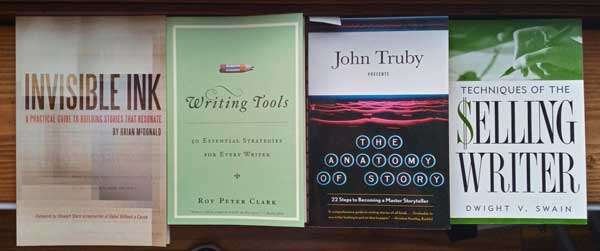
Invisible Ink: A Practical Guide to Building Stories That Resonate by Brian McDonald. Relatively short but NO filler. He tackles big subjects like theme in an insightful yet digestible way.
Writing Tools: 55 Essential Strategies for Every Writer by Roy Peter Clark, which I refer to as “the sentence-writing book” and gift whenever possible to anyone who writes (students, bloggers, fiction writers, letter writers—every writer, like it says on the tin). This is very much a “tools, not rules” book. There are detailed explanations of what writing “no-nos” like adverbs and passive voice actually do, so you can make educated decisions about when they are indeed the tools you need and when you should find better options, with emphasis on authorial intent and purpose, which sometimes run perpendicular to “rules.”
Techniques of the Selling Writer by Dwight V. Swain. Contrary to the title (complete with a $ replacing an S on the cover), this is not a “do as I say and you’ll get rich” specimen. His premise is that novels are about feelings—the author’s and those the author aims to evoke from readers—and there’s no one-size-fits-all writing formula for precisely that reason. Chapter 2 is all the attention he gives to grammar, and the rest is… philosophy. This book fundamentally altered my attitude about writing, which had been poisoned by 15 years of publishing, at a time when I desperately needed an attitude adjustment. It helped deprogram me from bad habits forced upon me during 15 years of writing to order.
Asterisk that this book was published in 1969 and contains a handful of sentences that don’t pass the 21st century progressive sniff test (which makes a takedown of toxic masculinity quite a surprise) and some writing style that is no longer fashionable (e.g., death by a thousand filter words). Also, an approach I consider “brusque curmudgeon” has been described by others as “condescending asshole.” (Ahem, let me introduce you to Egri…) If you can’t get into his narrative approach within a few pages, don’t torture yourself. People riff on Swain all the time, so you can acquire most of the good info from different sources.
The Anatomy of Story: 22 Steps to Becoming a Master Storyteller by John Truby. If plotting gets you high, this is the good shit—7 steps before you plot, 22 steps for the overall plot, and 9 steps per scene. This is how I ended up with a 95-page planning document for KotSQ, the first 40 pages of which was connecting dots to make a frame for the plot outline to hang from, because before you even get to the plot, Truby believes you need theme, characterization, and a well-built world from which the plot grows. There are 38 pages about symbols that might not make you their biggest fan but will at least slide a pot of possibilities on your back burner. He doesn’t even get to plot until page 258, at which point it’s “simply” a matter of translating all that groundwork you’ve done onto the subtitular 22 steps.
I wouldn’t recommend this one for beginners. It’s a lot to take in all at once if you’re encountering all of it for the first time. Once you have a foundation, it’s more of an “I already know this”/”ooh, this levels up what I already know”/”cool, entirely new information!” experience than a crushing dump of concepts.
Is there writing advice you used to follow but changed your mind?
Almost everything taught in school. Schools train future workers to write business correspondence, beige and standardized, devoid of artistry and feeling. I had to argue style as early as fourth grade. (When I write “X and Y and Z,” it is not a mistake that should be corrected to “X, Y, and Z,” dammit. People have no sense of rhythm!)
There was a brief period in which I attempted to get a perfect SEO score on blog posts, but “use simpler words, shorter sentences, and repetition like your audience is not-very-bright toddlers” quickly filled me with rage, so I stopped.
I’m working on purging “never use parentheses in fiction” after seeing the reason was “because people don’t think in parentheticals.” I do, in fact, think in parentheticals, asides, and even footnotes. This “rule,” therefore, has a flawed premise and shouldn’t be taken seriously. (One of the books above recommends finding out the origin of a “rule” before giving it any credence. Which is good advice in many areas of life!) Hat tip to Stephen King and a recent Dark Tower re-read chock full of punctuational hugs for kicking off this liberation.
“The POV character can’t know what other characters are thinking, so you have to say other characters ‘seemed to’ understand/think better of it/whatever” makes sense on the surface. However, I noticed while writing a mostly-single-POV book that this creates a high volume of seemed-tos compared to multiple-POV stories, in which every scene change is an opportunity to get directly into the other character’s head and explicitly reveal their thoughts, no guessing required. Take away that opportunity and the one POV character is left with “seemed to, maybe, I’m not really sure” every time they observe another character’s reaction. It’s obtrusive writing, and it makes the character look weak. Furthermore, I DON’T DO THAT IN REAL LIFE. I know when someone understands what I’m saying or not. I know when someone’s biting back what they really want to say. I know when someone’s lying. I may occasionally be proven wrong later, but in that moment of observation, I have conviction, not “seemed to, maybe, I’m not really sure.” So no more “seemed” unless my intent is specifically to convey lack of conviction.
Does your MC feel understood? Why/why not?
Overly so. The element of surprise is sorely lacking when one enemy has a presence in one’s veins and the other kept one tucked under a wing for 20 years, clinically observing every move.
Hero over there thinks he knows something, but he’s delusional.
How much power does your MC have?
Institutional power? None, at the moment. Social power? Quite a lot. Even people who dislike her personally either hate the villain more or support Heroine’s goal.
She also has an abundance of The Power of Rock Bottom. She doesn’t have a lot to lose, and if she yields, her enemy will destroy it anyway out of spite. Therefore, she can’t be compelled to yield. Victory or death, and she’s not easy to kill.
Her vastly more powerful enemies are sweating a little.
How much power does your antagonist have?
Human antagonist: Nearly as much as she wants. Works for one crown, is civil-unioning into another, and plans to plunk a third on her own head soon. Generational wealth. A small army of trained killers. Two decades of insight into what makes Heroine tick.
Nonhuman antagonist: Physically formidable (enormous, armored, fanged, clawed) and magic surpassed only by gods.
What communities play a role in your story?
Traveling theater groups. The fiber guild. Crime syndicates.
Is your MC spontaneous, or a planner?
She prefers planning—six months of preparation does wonders for one’s success rate—but she’s lucky if the present situation gives her 6 seconds to think through her next move. She’ll improvise out of necessity, but she won’t like it.
Do you plan out your themes or allow them to develop as you write?
I plan; they develop. There is no way to plan a story in which I don’t gain deeper understanding during the writing of it. The preliminary theme gives me a thread to follow through the dark. When I get to the end of the path and know for sure what I passed along the way, I know the landmarks of the evolved theme and can revise with that in mind.
Do you include characters from all socio-economic classes in your story?
From swamp hobo to king.
Do your MCs have any luck in love?
Hero has been in love at least once, but due to the nature of his curse, he was taken from it. (No love interests were killed in the making of this heartache.)
Heroine has never tried her luck, on the presumption anyone she cares for will quickly be seized as a tool to control her.
In your story, who’s hiding (literally or metaphorically)?
Hero is hiding his hands, one of which bears a problematic mark, and he lies about who he is because the truth is unbelievable. At the beginning, Heroine is incognito in the marsh, and she’s an anonymous benefactor to her long-lost family. Multiple characters are in the equivalent of a witness protection program. Human antagonist sure isn’t being open about her maneuvers, which must be gradually uncovered. Nonhuman antagonist’s motivation is so obscure, it will take most of the series to uncover it.
Who’s blaming who in your story?
Heroine is more interested in responsibility and justice than blame. Finger-pointing without corrective action is tacit approval.
Hero has long blamed himself for a curse that went into effect when he was a child, but as Heroine, who has a better view of the situation from a distance, points out during the story, that’s ridiculous and should cease immediately.
Do you have an irrepressibly good-humored character? How do others react to them?
Nab is good-humored about things that unnerve most people. For example, in a before-the-story story, she’s super cheerful about being robbed, calling helpful advice to the assailants.
Does your MC have any pets? If so, what are they?
Heroine liberated an abused horse that followed her at a safe distance until it decided she was okay for a human and consented to pull a wagon and occasionally be saddled. It doesn’t have a name, and she’d describe it as a business associate rather than a pet.
She put herself between her business associate and the story equivalent of a rabid tiger in the first scene and risked getting caught by enemies to leave her business associate someplace safe before embarking on the more perilous portion of the quest.
Clearly not a pet.