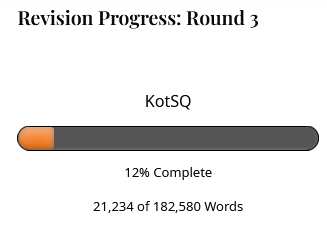
 Revision III resumes in Heroine’s POV. Pretty sure this is her first scene of this pass in which I added more words than I deducted.
The deductions were mostly the author’s compulsion to overexplain infrastructure. If I provide one solid reason why she doesn’t go one way, I don’t have to provide six reasons to justify going the other way. One “it’s the opposite of the aforementioned deterrent” suffices.
The extra words mostly went toward beginning to establish the “complicated” feelings about the mentor who now wants her dead. That showdown is a long way off, but we shouldn’t get there and still be thinking the obvious action will be an easy action.
I’m in the midst of a life upheaval that has turned up the difficulty level of both finding time for this book and concentrating on the depth of work I’d prefer to be doing. Most of this installment’s progress was fiddling rather than substantive.
*puts on optimism hat* Yay for fiddling I won’t have to do in Round 4? Or maybe this section was so awesome it didn’t need any deep work and I’m just not in a place right now where I can recognize greatness!
There were a couple of pages heavy on was/were.
I’m not anti to-be. Sometimes a thing just is, and you note that and move on to something livelier.
When you have a concentration of to-be, it’s a sign that nothing is happening. Sometimes you can juice up enough verbs to disguise the stasis. For example, instead of “Her hat was lopsided,” you might try “The hat perched at a jaunty angle atop her copper curls.” That feels less static, but pages of such contortions won’t convince readers something is happening.
Mostly, you need to reevaluate what you’re doing with that long stretch of no action. Can you inject tension into the stasis? Replace it with something that moves? Cut it and transfer any important info therein elsewhere?
In this case, I know I added a transitional passage during a phase when I was obsessed with the logistics of how long it took to travel from point A to point B. Never in all my years of reading have I given a damn about how long it takes to get from point A to point B. If somebody writes characters traveled from London to Glasgow by carriage overnight, my eyebrows might raise a little bit, but my brain will process “okay, we’ve elided some quantity of boring time, just get to the good part.” And even that minor dissonance could be avoided by simply not specifying the amount of time involved. (“We arrived the next morning” vs. “when we arrived…”)
This time, yeeting almost that entire transitional piece resolved the prolonged “things exist in their state of being” problem.
Sometimes we have to write words to get something (like empty logistics and infrastructure) out of our system. The focus of editing is shaping the readers’ experience. Does this information benefit the reader in any way? No? Then buh-bye.