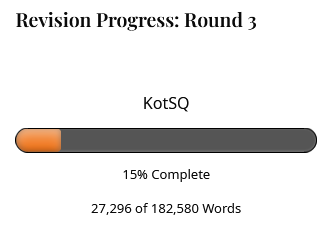
 This revision update gets us past the end of Act 1, which is marked not by some formulaic percentage but by Heroine being forced into the thick of the quest she had previously refused twice. Act 2 starts at that point of no return, where it’s physically impossible to walk back her decision. Like it or not (very much not), she’s stuck, if not yet committed.
Act 2 is the doing of the quest and all its complications.
I was today years old when I learned “secreted” as in “made one’s location a secret” is not secret-ed but secrete-ed. Secrete as in “ooze” has a secondary definition of “conceal” because language loves giving the middle finger to clarity.
I used to edit “secreted” out of finals because I didn’t want people to read it “the wrong way,” but now that I know all ways are pronounced secrete-ed, I feel betrayed. Our love has died. I want a divorce.
Typos are loud when they come out of your mouth.
I was reading for speech therapy when I came across “forching” and dissolved into a puddle of breathless laughter.
Which I then exacerbated by reading the next page with unnecessary aitches inserted into every word à la J.R. Ward.
Lots of going back to address “go back and ____” notes I’d left myself. Minor stuff, like reminding you of an injury and demonstrating that I recognize the oddity of assassins parading around in uniforms in plain sight and it will be relevant later so just roll with it.
Also filling in blanks with names I did go to a great deal of trouble to select, eventually, but never went back to insert them where I had previously either left a blank or used a placeholder like KingName, just to make the holes more challenging to find. Sometimes I even took a stab at remembering the name and got some of the letters right! (This is going to be a miserable proofreading job.)
Nitpicky stuff like changing “she didn’t know of any that [did XYZ]” to “she knew of none that [did XYZ].” Generally, if at all possible, it’s better to avoid nullifying verbs.
“She didn’t eat the avocado.” Okay, but what did she do in relation to the avocado? Throw it out the window? Summon up a portal and banish it to the realm of mealy muck from whence it came? Delicately push it and everything it touched to the edge of the plate and politely eat the uncontaminated portion of the meal? What didn’t happen is rarely more interesting or important than what did happen.
Sometimes (for instance, the non-avocado example above) the switch seems to make no functional difference. I like to change them anyway, both to practice good habits and sometimes just for vibes. Knowing is aesthetically superior to not knowing. One can not-know to the point of empty-headedness; knowing implies a degree of knowledge from which a specific unknown thing is excluded, an outlier rather than broad ignorance, and I like characters who know things.
(Yes, I constantly think about these distinctions no one else will ever notice. I talked about this once in front of a group, and two camps shouted, simultaneously, with equal conviction, “Art!” and “Autism!”)