UPDATE: Now on YouTube, only 5 months later! (I’m not embedding video here because it spoils my “no tracking, no cookies” policy.) This text is the script for that video, so you’re missing nothing if you stick to one medium.
On winter solstice, the birds disappeared, and the mist arrived.
The inhabitants of Nebulah quickly learn not to venture out after dark. But it’s hard to stay indoors: cabin fever sets in, and the mist can be beguiling, too.
Eventually only six remain. Like the rest of the townspeople, Pete has nowhere else to go. After he rescues a stranded psychic from a terrible fate, he’s given a warning: he will be dead by solstice unless he leaves town—soon.
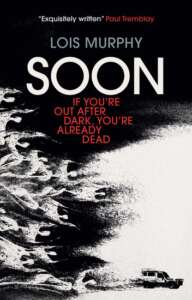 Soon by Lois Murphy is a 2019 horror novel set in the small Australian town of Nebulah. Between darkfall and daybreak, Nebulah is filled by mist that brings the dead, who want the living to open their doors so they can play together. All night, every night, they scream and beg and scratch at the windows.
Obviously, the few people left in Nebulah are well-rested and in great mental health.
When I talk about horror, it’s a public service to provide some context. In real life, I’ve been through some shit. As a result, nothing in a book or movie scares me. It might be gross. It might be strange. If I’m lucky, it’s interesting. But if you ask me how scary it is on a scale of 1 to 10, my answer will always be 0 because I’m not scared of imaginary danger. This is not a comment on how anyone else engages with horror. People are different, and in a functional society, difference is our strength! This is just a heads up that if you want to be piss-your-pants scared or want to peek through your fingers in just a couple of spots, I am incapable of placing a piece of media on that scale for you.
We now return to your regularly scheduled book review.
The story begins not at the beginning of this nightly phenomenon but 9 months into it. The characters who’ve held it together this long are experienced. They’re clock watchers. They have routines. They plan every day around being locked up tight before nightfall. They could, theoretically, continue to survive this way until they die of old age.
They have perhaps become a little too confident in their survival skills.
The problem with survival via routine is that if anything doesn’t adhere to the plan—if, for example, someone has to stop to educate a clueless traveler too late in the afternoon—they could easily miss the safety deadline and join the dead tormenting their friends.
That is, in fact, the first close call Pete, our point of view character, experiences. One afternoon he spots an unfamiliar car creeping through the abandoned town. It’s getting late, he needs to get home, but he can’t let this rubbernecker die in the mist, if for no other reason than it would add one more to the ghosts haunting the town.
By the time he catches up with the interloper, there’s no time for anything but “we have to take shelter now,” and they arrive at Pete’s house with the mist rolling in at their heels, not quite formed enough to grab them. Now that Pete’s locked up with this woman for the night, she reveals she’s a psychic. She tells him he’s going to die in 8 weeks, on the solstice, if he doesn’t get out of Nebulah.
Pete seems like the kind of guy who would instantly dismiss anyone claiming to be a psychic as a crank, but after 9 months of killer mist, “you’re gonna die” is just stating the obvious. The date is the only wild card, and he finds himself believing her about that. The problem is, if leaving was a possibility logistically, he’d already be gone.
The thing I love most about this book is the socioeconomic horror baked into it. I complain all the time about authors who’ve obviously had plenty of money every day of their lives and their obsession with writing about impoverished characters who behave as though they’re solidly upper middle class. To those authors, poverty is an aesthetic choice—just like being rich, but grimy—no effect on way of life whatsoever.
Lois Murphy has either been poor or did really good research because she gets it. Nebulah didn’t have much of an economy, other than a bar, to begin with. The only person who has any source of income after 9 months is Li, the farmer, and the grocer who buys her produce in the nearest town basically does it out of charity. No one can sell their house or land because this location was never worth much anyway and is less desirable real estate now that it’s either haunted or the residents are running some kind of scam.
This phenomenon was national news at the onset, but the cameras were unable to record anything beyond what looks like ordinary fog, so the whole country decided it was a hoax. Imagine leaving and applying for a job and the background check flags you as an infamous resident of Hoaxtown. Yeah, don’t sit by the phone waiting for a callback.
I had to put the book down at one point and have a rant because if this supernatural phenomenon had befallen an upscale subdivision, the rich people would have been on the phone with the politicians they golf with and had it officially classified a natural disaster, raked in government relief and full homeowners insurance payouts, and settled into a different upscale subdivision with minimal disruption of their lives. The media would portray them as tragic victims because (sarcasm ON) rich people would obviously never scam anyone. (sarcasm OFF)
The rules are different for the poor slobs in Nebulah. They’re physically free to leave. There’s no physical or supernatural barrier keeping them inside. But they have no money to go elsewhere, no in-demand job skills that would make them welcome elsewhere, so they’re socioeconimically trapped, much as they were prior to 9 months ago, but now with an added supernatural threat trying to hasten their deaths and an outside world that has a bonus excuse for not caring about them.
For me, not getting a definitive answer about the root cause of a supernatural phenomenon is part of the horror of it. If you don’t know what happened, you can’t stop it, you can’t prevent it from happening again. You’re powerless, and isn’t that the essence of horror? People aren’t afraid of things they can control. But if you’re the kind of reader who needs to know why the horror is happening, be forewarned this book won’t give you that satisfaction. We find out what happened immediately before the killer mist started, but why and how and why now are unsolvable mysteries beyond the ken of its victims.
It’s difficult to do content advisories for horror because the whole point is being full of upsetting things. The one that could do the most harm is suicide, which isn’t a spoiler because there’s one in the first chapter. Oh, and for the pet lovers, the dogs are not okay.
The upsetting things do not include rape.
This concludes the short version of my review of Soon by Lois Murphy. Strongly recommend. Five stars. No caveats, and if you’ve read any of my less-positive takes, you know I live for an enumerated list of flaws from no logic to crimes against punctuation. I’ve read this book twice, and nothing irritated me. In fact, I enjoyed it more the second time because I could spot the warnings disguised as mundane commentary and get the full “oh nooooo” experience. I wouldn’t hesitate to read another book by this author with no further information necessary, trusting I was in competent hands, which is the highest praise from me.
Why is there so much post left? Because now I’m going to get into particulars. If you want to read this book unspoiled, you should click away now. If you know you’re not going to read the book but can’t get enough gabbing about books or if you plan to read it and like being prepared, follow me into the Spoiler Room for an additional 14,000 words of spoilerific fun.
Earnest final warning: ALL the spoilers, including the ending, lurk below. If you want to read the book unspoiled, stop reading this, go read that, and then come back if you want to compare thoughts.
By opening a spoiler tag marked “Spoiler Room” and ignoring an earnest final warning that reading further will expose you to spoilers, you hereby accept all responsibility for spoiling yourself.
The Characters
It’s a strange, and I think inherently human, trait that no matter how few members of a group there are, it will always divide itself into alliances, never stay completely homogeneous.
Before the story started, the 11 remaining residents of Nebulah had been in 3 small groups. Pete, Li, and Milly are long-time friends. They have all the well-socialized dogs, to make sure we know where to pledge our allegiance. Gail and Tom are married, and Stick attached himself to them because… no one else would have him or them. And Liz and her 3 boys lived next door to Rolf, so it was easy for them to look out for each other. They are a community, they pool resources and services, but when they leave collective situations, they preferentially fall into those three clusters.
Those are the natural fault lines.
Rolf was a recluse, a grumpy old guy who never wanted anything to do with anyone, until a young single mother, Liz, moved in next door with her 3 boys. (This was before the killer mist, obviously. Nobody thought, “hey what a great environment to raise my children” and moved in after.) Rolf took to that family, and he was the only authority figure the boys respected. But one night, the killer mist impersonated the boys, and that was the breaking point for Liz. She’d rather they were homeless and living in the car anywhere else than spend another night in Nebulah, so she packed the boys in the car and left. That family was the only thing Rolf cared about. He had no other reason to want to be alive in Killer Mist Town, so a week after Liz and the kids left, he decisively solved that problem, which Milly discovers in the first chapter when she drops by to check on him.
The Liz-Rolf cluster is no more.
Pete calls in cops from the nearest non-haunted town, Woodford, to report Rolf’s death and have the body removed. Cop Sean is an old pal who knows everybody and understands the situation. He’s accompanied by Cop Greg Denham, who is new and crisp, and though he says nothing during this encounter, he’s sneering and suspicious. We learn eventually that Pete was an indifferent cop, and it’s delicious later when he has to deal with this young cop who’s indifferent to his problems.
I love when writers put characters face-to-face with some element of themselves and make them confront how much they suck.
When the outside authorities leave, 5 of the 6 remaining residents of Nebulah convene at Pete’s house for a solidarity sleepover. (Li is absent, having gone to Woodford to sell her wares and pick up supplies. Since that town is 3 hours away, she always stays there overnight rather than trying to get back to Nebulah before dark.) There are only 2 groups left now, and when they’re all crammed together, you quickly see why they’re split. Pete and Milly are completely at ease with each other. Tom is a drunken, apathetic lump. Gail is needy and relishes performative crying. And this isn’t a recent development in response to the killer mist—their adult son moves around a lot so his annoying parents can’t contact him easily. Our last pal, Stick, is an unwashed loser who stares at what you have like he expects you to give it to him and gets sullen when you don’t. He has a muscle dog that has to be locked in the laundry room away from the other dogs because he’s taught it to be aggressive.
Stick uses the abandoned land, lack of witnesses, and absence of pests in Nebulah to farm weed on a commercial scale. Pete thinks he might someday mention this to Cop Sean.
For now, though, he’s number six, and that’s all that matters. We can’t afford to lose any more.
When I read that I thought “Stick isn’t a person who will step up to help in an emergency, so nothing of value would be lost,” but I suppose since their number plunged from 11 to 6 in the past week, Pete might be feeling a little protective of what’s left, regardless of its value. Pete’s fatal flaw is trying to redeem his history of neglecting others by being a self-appointed protector in the present.
The next day, Li is late getting back from town. When Pete calls to check on her, she says she has a flat tire, in addition to a chronically overheating engine, but should be home in half an hour. An hour later, Pete and Milly are still waiting for her. Pete considers mounting a search but decides against it. Li knows what the stakes are. Stubborn independence isn’t a virtue when up against a killer mist. She’d call if she needed help.
Only when reading this book the second time, already knowing everything that happens, do I pick up the casually dropped, easily overlooked lines of foreshadowing in the present story. Words as mundane as “she’d call if she needed help” become devastating through the lens of hindsight.
Li arrives home with just enough time to bring in the groceries and the dogs. Pete reckons Li’s truck is in its final days and they need to figure out a better transportation solution. Li says that won’t be necessary because the market where she sells her produce will probably be out of business in a month.
This is 15% into the book. They’ve lost nearly half their people. They’re losing one of the very few vehicles that give them mobility. And they’re losing the only source of income anyone has, other than the weed dealer, whose idea of sharing flows exclusively toward him, not from him. It’s been a rough 2 days that will make going forward more difficult. They’re confined at night, and their daytime freedom is shrinking.
The Mist
The book delivers information about the killer mist in dribs and drabs, which I’m going to consolidate here.
At first, the mist is just a reason people need to be inside before dark. It might be poison, for all the reader knows.
Then we learn Li’s crops are thriving because the pests are all gone. No birds or other wildlife.
While Pete is waiting for the others to arrive at his house the first day, he notes at any time of the day other than dusk, sitting on his porch watching the trees sway in the breeze would be comforting.
The others had better get a move on if they’re coming. The mist will start soon, tendrils winding through the evening breeze. I give them half an hour at the most.
It’s vague. It’s time sensitive. But “tendrils winding through the evening breeze” doesn’t sound menacing.
But then, once the people and dogs are locked up in the house, safe in their routine:
Outside, the whispering is starting, curling round the house with the wind.
I stand up; it’s time to serve some food. Once the whispers build, it can be challenging to eat anything. On my way to the kitchen, I switch on the television, loud.
While they’re eating, the whispers escalate to wailing. That’s gonna make it hard to sleep, every night, for 9 months.
The day the mist started, a convoy of “silent grey vehicles” rolled into Nebulah and disgorged a bunch of Men in Black who looked around but didn’t interact with anyone before piling back into their vehicles and driving off, not back to wherever they came from but out to the cemetery, way off on a dead end.
One dubiously reliable witness claimed the men had no shadows.
Pete and Sean and a bunch of Nebulahns drove out to the cemetery to find out what was up… and there was nothing there. No Men in Black, no grey vehicles, not even tire tracks. No way they could have backtracked and left town without running into their pursuers. They just vanished. Beamed up into a UFO? Opened up an interdimensional portal and drove through? Megatronned into jets and flew away? Nobody knows. There’s no explanation.
As that day turned to night, the killer mist rolled through Nebulah for the first time.
Everybody was perplexed and unsettled by the disappearance of the Men in Black. People were talking about it in the bar. One guy got pushy-shovey in promoting his pet theory, and the bartender threw him out. A minute later, that guy came stumbling back in, looking “pale and wild.”
“There’s something weird out there. For fuck’s sake, look at this.”
His fear was electrifying, and a small crowd moved to the windows. Daryl Burcott gave a snort. “Yeah, right, mate,” he grunted. “It’s foggy.” He turned back to the bar.
“It’s got people in it!”
“Yeah, it has. It’s called a street.”
“No!” Jonesy was starting to seem a bit demented. “Not like…”
“Jesus!” someone at the window called. “What the hell is that?”
This thick fog is rolling down the street with intent. As it nears, they can see figures in it. The mist hits the windows, and faces and hands press against the glass. The people trapped in the bar gradually shift from terror to disbelief. This can’t be real. It has to be a prank for TV or something.
But when the mist starts chanting “come out,” they unanimously decide it’s a good night to sleep in the bar.
They hear a car engine outside, and the mist peels away from the windows. Someone declares this abrupt cessation proof that the perpetrator of the hoax got scared off by the car. When he turns around to sneer at everybody for being such cowards, a bloody body thuds against the window behind him.
They call the cops, but a bunch of pub patrons making wild claims about killer mist aren’t exactly credible. The cop on the phone says it was probably a bird that hit the window and everybody should go home and sleep it off.
Nobody leaves the bar that night.
The mist departs with the night. They find the abandoned car in the morning, registered to a tourist. The body is gone. Even the blood on the bar’s window is gone. There’s no evidence of foul play. The cops declare the guy missing, but there’s nothing to investigate.
But Martin de Witt wasn’t missing—he was back the following night, a gasping, bloodstained apparition in the heart of the swirling fog.
In the following nights, the guy who was so sure it was a hoax went out into the mist to find the hoaxster and disappeared. He came back in the mist the following night. This repeated a few more times, taking out the most confrontational Nebulahns, before people caught on and started to lock themselves in at night. Without human prey, the mist started taking livestock and pets. The birds disappeared.
A guy who raised bespoke cows lost them all to the mist and was pissed about it. No evidence of a crime, and he couldn’t collect insurance without a police report. He was ranting about this when his buddy interrupted him. The mist came rolling in, a bunch of skeletal bulls draped in torn flesh plodding within it. The rancher marched out to yell at the mist and got trampled to death by ghost cows. The mist, insubstantial as it may appear at a glance, can gather enough substance to make mince of a body.
People who were able to leave did.
Of course people speculated. Some thought the Men in Black had something to do with a chain supermarket trying to build in Nebulah, running the mom-and-pop grocer out of business but promising better inventory and more jobs, dividing the town along lines of tradition and progress. There was no real reason to believe in this connection—unleashing a killer mist isn’t a standard part of opening a grocery store where I’m from—but because that was the only major drama preceding the mist, a lot of people seized upon it. Others said the land was haunted by long-ago murdered miners or noted that there had never been Aboriginal people in the area, despite its pleasant climate and fertile land, because it was a rotten place. Neither of which explained why suddenly this became a supernatural crisis.
If you need to know what happened out at the cemetery, you’ll probably hate all this and think it’s an oversight, but for me, that’s what makes this horror, more than the killer mist. The Men in Black come, do something unknown that kills a bunch of civilians, there’s no one to hold responsible, you can’t do anything to fix it, you don’t even know why, what their objective was, and they—whoever “they” are, this anonymous villain—can do this again, whenever, wherever, to whomever. Maybe this was a test run. Now they know what happens inside the affected zone and the reaction outside the affected zone and can adjust for any results they don’t like the next time they do it. The world goes on, there’s a future beyond the end of this story, and it could be made even worse for a new set of victims. I like horror that ends on a dread note rather than a tidy bow of certainty.
Speaking of dread notes…
The Turning Point
The day after we’re introduced to Li, Pete is test driving a patch job he did on her truck when an unfamiliar car passes him, heading into Nebulah. He can’t chase it because he has to stop and let the engine cool down. This isn’t a good pursuit vehicle, so he goes back to Li’s place to get his own ride. By the time he gets back to town, he can’t find the car anywhere.
The stranger eventually finds him, by which time they have to race to shelter, the mist chasing them up the porch of Pete’s house. Once they’re locked up, she introduces herself as Alex and says she’s a professional clairvoyant. Pete hasn’t been impressed by the self-proclaimed psychics who’ve shown up in Nebulah previously, but to his credit, he says a man who lives in a town tormented by killer mist isn’t in a position to be closed-minded.
Alex says she was driving around on holiday and rear-ended another car. She describes the other driver as “psychically distraught.” It was Liz, the woman who fled Nebulah with her kids, and she was desperately worried about Rolf. Alex got emotionally infected with that anxiety and came looking for Rolf to settle her own mind, one way or another. She’s not surprised to learn of his death.
“Why do you stay?” she asks.
“You’re the mind reader.”
“There must be somewhere you could go.”
“An invalid pension won’t even cover rent in today’s market.”
“But wouldn’t the government help?”
“They don’t want to know. Way out of their jurisdiction. Exceptional circumstances don’t cover haunting. It’s been made clear that as we don’t fit into any of their categories, we don’t qualify for assistance, case closed.”
This is how you do spoken exposition. You have someone on the inside explain the thing to an outsider who doesn’t already know what they’re being told and would therefore reasonably have questions about it. The next time I have to read a character explaining something to another character who already knows all about it as a ham-fisted means of passing information to the reader, I will set something on fire with my mind.
Alex has a rough night. Anyone would, their first night with killer mist howling on the other side of a wall, but whatever psychic channel she has was open to its energy, and it zoomed in like it would through an open window. She didn’t sleep at all because she had to keep it walled off from the rest of her mind.
Pete asks if her contact with the mist gave her any insight into what it is, what caused it, what it wants, anything. Because after 9 months of it, all they know for sure is that it kills most living things that get caught in it. (Many people who evacuated left their dogs behind. The pack went feral and became a daytime safety hazard because the mist didn’t claim it at night.)
Alex didn’t learn anything about the mist’s origin, but she describes it as “human nature unfettered, unrestrained.” Because all good behavior is a social veneer and true human nature is vile and we all have torture and murder inside us.
Now I’m going to have a little rant about this because gun-humping rapist abusers would love everyone to believe they’re just more in touch with their essential humanity, more honest than everyone else, and every “people are shitty by nature” claim enables them.
Being a decent human being isn’t a “veneer,” except in the case of awful human beings disguising themselves to gain access to victims. If we, as a society, would say “this behavior is unacceptable” and impose meaningful consequences for being a rancid sack of pus, fewer people would think they have permission to be a rancid sack of pus, and whatever vestigial organ of rancid pus sackery you think is so “natural” would shrivel up and fall off.
Stop validating people who enjoy being rancid sacks of pus by calling “rancid sack of pus” human nature. As mentioned earlier, I’ve been through some shit, at the hands of rancid sacks of pus, so I’m well aware they exist. And I know they could have been stopped, at any time, by someone who wasn’t a little kid, by saying “this will not be tolerated” because I, at the age of 12, was able to put the fear of consequences into a rancid sack of pus and finally make it stop, and I didn’t have to harm anyone to do it. It’s not impossible. You just have to not accept “rancid sack of pus” as an inevitable condition. And when it flares up again, you have to respond to it again, not roll over because you failed to defeat all evil forever in one ultimate move so resistance is futile. Sorry to be the bearer of bad news, but you do actually have to work at enforcing the social contract when others are working to violate it.
Shitty behavior seems prevalent because so many people have normalized and enabled it by repeating “human nature is vile” because they want to believe being a decent human being is a feat of heroic virtue rather than a bare minimum expectation that requires no more of them than Do No Harm. Being vile isn’t the baseline. It takes effort to be vile. Being passively not-vile is the baseline. A person in a coma can manage passively not-vile. You don’t get to pretend you’re a hero without putting in any effort, by acting like you’re a powerless baby and have no effect on anyone or anything so taking any action is pointless.
Stop saying it’s normal to be shitty. It’s deeply abnormal. Human beings have such complex survival needs, it is impossible for us to have survived as a species without cooperative effort. Being shitty is a flaw that threatens the welfare of the entire group and should not be accepted because you’re too “nice” to say “knock it off or you get to find out how tough and independent you are when you’re turned out with nothing the group supplies.” Exile was a no-actual-blood-on-your-hands death sentence for a long, long time before people could cosplay lone survivalist with all their factory-made gear and mass-produced clothing and shrink-wrapped food ordered off Amazon and delivered by FedEx. People who build together are intrinsically more valuable than assholes who gleefully destroy, so stop saying the latter is the “norm.”
Pete offers to take Alex around to meet Li and Milly before she leaves. Alex has an intense negative reaction to every mention of Milly. The first time I read it, I thought they must have some history that made Alex want to stay away from her because people don’t react that strongly to strangers.
Alex tells Pete he has to get out by solstice, which is 8 weeks away, and then she hightails it out of Nebulah. When she calls Pete later to let him know she arrived safely at a motel in Woodford, she tells him she didn’t want to meet Milly because Milly is the reason he’s going to die.
Pete presumes there’s no way he can convince Li and Milly to leave within 8 weeks, and he won’t leave without them, so he just accepts his doom. He’s tried nothing and it didn’t work, so that settles it!
Why are these dang women so stubborn?
Milly’s husband died in a car wreck years before the onset of the killer mist. Milly retained her composure when Pete broke the news to her. She did her mourning with quiet grace.
In all the years I’ve known her, I have only seen Milly lose her balance once, when she collapsed under the strain of the horror of Gavin’s reappearance, in the first nights of the mist.
In the face of Gavin’s nightly pleas to her to come outside and help him, Milly caved in, her reserve rupturing like the crust of the earth when the pressure from below is too great to contain.
Those terrible nights were defining for us. Milly’s collapse was too profound, too confronting for the remaining Nebulah inhabitants to cope with. Although most of them were sympathetic, the situation was too disturbing for them, an internal combustion that simply couldn’t be endured given the external pressures we were under. Some, like Gail, simply lacked the basic human qualities of empathy and compassion and disguised these shortcomings by attacking Milly, distorting their own callousness by insisting that what was in their own best interests was also in hers. They wanted her hospitalized.
We splintered.
Milly knows the mist is only impersonating Gavin, as it does with so many others, but she has a lingering fear that his spirit is trapped here, a hostage of the killer mist. They know nothing about how it works, and ignorance invites imagination to do its worst, so she won’t abandon Gavin’s theoretical spirit.
Li joined us. She had always been a loner of sorts, but not a hermit in the sense that Rolf had been. She was what is commonly termed in a small population a “character,” an aloof and focused woman with no time or respect for the usual female interests. Her humour therefore tended to be unexpected, which made it—and her—seem unpredictable. She and Milly were compatible by temperament, with the sort of unselfconscious nonconformity that was often labelled eccentricity. Li was a small person with an incredible backbone, which had supported her through her flight from the massacres of Cambodia.
Where her husband and 2 sons died. She rebuilt her life here in Nebulah, from nothing, and she won’t flee her home again. More than any of them, Li knows how hard it is to recover from nothing.
Milly and Li are determined not to be driven from this place which is entwined with their souls, whereas I, quite simply, have nowhere else to go.
The Culling Continues
Milly cuts Pete’s hair in the kitchen.
There was a time when this sort of thing would only have been done outside, but these days we’re superstitious, wary of leaving any part of ourselves outdoors.
I bring this up because I thought it was an interesting detail. The mist takes the form of the dead buried in the cemetery and those it’s killed throughout town, but it doesn’t, for example, send a fake Pete pounding on Milly’s door, which would probably be really effective for gaining entry. It was, however, able to impersonate Liz’s kids to freak her out. Maybe the boys were getting cuts and scrapes and leaving enough blood and tissue around for the mist to make use of? So hair clippings might be enough material to assemble a form to deceive your friends.
This isn’t explored in any depth and doesn’t need to be, but it’s a neat “this is how we cope day to day” worldbuilding nugget.
Along with his fresh hairdo, Pete decides to cut back on smoking and start jogging to get back into shape. Some people respond to reduced life expectancy by indulging all their vices to the max, while others see it as a time to take up good habits they won’t have to maintain for long.
Stick calls Pete and tells him to come to Gail and Tom’s house. Gail twisted her ankle, fell, and probably broke her hip. She can’t even get up from the ground. It’s 4 in the afternoon, in winter, when the days are short. An ambulance can’t get there from 3 hours away before dark, and Stick and Tom have been day drinking and can’t drive. Pete has to get Gail into the car, badger Tom into throwing together a bag, and drive them to the hospital in Woodford.
The hotel is full, so Pete spends the night at Sean’s house.
When Pete visits the hospital in the morning, Gail’s hip is indeed smashed. She won’t be going home any time soon. Pete calls Milly to give her an update, and in turn, she tells him it’s official—the market didn’t get the loan so they’re closing at the end of the month and can only take one more order from Li next week.
Back in Nebulah, Pete comes across a second weed farm and realizes Stick’s operation is much more significant than he previously knew, and he, in ex-cop mode, goes to Stick’s house to confront him about it. “Give me the stash, I’ll destroy it, and you won’t have to go to jail, yadda yadda.” Stick responds “Don’t fuck with me or I’ll tell the cops you were in on it all along and turned snitch when I wouldn’t give you a bigger cut, and you know the press loves a dirty cop.” They end this pissing contest on a draw, antagonism sizzling in the air.
Pete never liked Stick, but now he’s made him an enemy.
Pete ventures back to Woodford with Milly. He still doesn’t tell her about the 8-week deadline weighing on him.
I have to be responsible for my own decisions; she does not ask me to stay here with her.
She would, in fact, sensibly tell him to leave. But we’ve already established he doesn’t have enough money to live anywhere else. He can’t sell his house and land because whew, property values in Nebulah, amirite? Milly already gave all her savings to get Liz out. He’s gotta be in his 60s, and trying to get your last job is even worse than trying to get your first because someone will eventually think “I can take advantage of this kid, you’re hired,” but hiring managers presume a 60-year-old is decrepit, set in their ways, won’t want starting wages, and will either die or retire in a hot minute, so his employment prospects are bleak. The only family he has outside is a daughter who hates him (more on that later). He can stay in Nebulah and die on the solstice (maybe, if the psychic prediction is even accurate), or he can leave and slowly die on the streets.
Nothing like cold, hard fiscal reality to make being ripped to shreds by a killer mist a viable consideration.
I’ve decided not to tell her about Stick’s little enterprise, either. He’s proving to be a vindictive little sod.
I shout this at a lot of media in which a man decides to “protect” a woman with ignorance: The threat doesn’t care if she knows about it! He wants to hurt you. He wants you to know he’s hurting someone because of you. If you don’t tell her, she doesn’t know she should be wary of this previously merely annoying dude.
In this one case—first time this has ever happened!—I believe this is a character flaw in Pete rather than a flaw in the writer’s logic. He was a failure as a husband, a failure as a father, a failure as a cop. He consistently casts himself in protector roles he’s just not good at, so he’s consistently making the wrong call here, as well.
Pete runs errands while Milly’s at a doctor’s appointment. He says the shopping is reduced by half because Gail and Tom are out for a while, and he refuses to shop for Stick. Okay, this is reasonable. Indeed, one might ask why they were ever running errands for a jerk who goes to town regularly to sell weed, other than to maintain a semblance of community spirit. But Pete has words with Stick once, about an issue he’s known about for the better part of a year, and suddenly it’s “fuck that guy.” And since Stick has exhibited no redeeming qualities, you’re thinking “yeah, fuck that guy” without noticing that Stick is the same as he ever was. What’s changed is Pete’s antagonism, Pete’s alienating actions.
Pete also goes into the police station to tell Sean about Stick’s much larger crop, but Sean’s out of the office. Denham is there, reading a magazine with his feet on the desk. He asks Pete, “Is it important?” And Pete says, “It sure is, so I’ma tell it to Sean, not you, douche.” (I’m paraphrasing the latter.) Would Denham be less of an indifferent cop if Pete had been nice to him? No! Denham is a static character, like Stick, who showed you what he was and will always be at his first appearance on the page. Nothing anyone does can change him in any way. But Pete chose to be antagonistic toward him.
Pete and Milly go to the hospital to visit Gail, but she’s been moved to a different ward and can’t have visitors. That’s never a good sign. They run into Tom, who tells them Gail now has an infection and is being transferred to a hospital in Perth. Support services have found Tom a place to stay while she’s hospitalized and arranged a nursing home for them both once she’s discharged. They are out of Nebulah.
“I have to say, it’s a pretty good outcome really,” he says of his wife’s grave condition. “I can’t see how else we would ever have gotten out of the bloody place. You just can’t live like that.”
Tom is the real winner of this story. He didn’t even have to break a hip to get social services to give him housing elsewhere.
And then there were four.
While they’re filling up the gas tank on the way out of Woodford, Pete suggests to Milly they’re too thinned out now. They have to leave. The three of them can get an RV and just be nomadic retirees. They’ll figure something out. Milly entertains it while she thinks he’s joking, but once she realizes he’s serious, she says again she can’t leave her husband trapped in the mist. And even if some miracle happened, like Sean offering Pete a job manning the desk at the police station, he wouldn’t leave Milly and Li because he’s the self-designated protector. That’s his whole identity. He has nothing else. He won’t leave as long as there’s anyone left to protect.
Remember, Pete has chosen not to tell Milly and Li what the psychic told him, new information that might influence their positions. Saving his life might be more important to them than their current reasons for staying. They could at least kick around ideas together. The ladies could make informed decisions. But no, he must manfully suffer in silence! This is how you turn a virtue into a character flaw. Oh, the protector looks out for everyone’s safety, great. A lot of writers who bother trying to show the negative side of that trait go full mustache-twirling evil. “I will lock you in a cell where nothing can harm you ever again, mwahahaha!” That’s goofy. The journey from “I will protect you from things that will maim and kill you” to “I will protect you from information I’ve decided will upset you” is plenty far enough to deprive others of agency and cause extensive damage while maintaining a claim to good intentions.
Flashback
There’s a lengthy flashback in which Pete goes to Sydney to spend Christmas with his daughter Julie. It was a spite invitation to protest her mother’s choice to spend Christmas with her new boyfriend instead. Pete and Julie have been estranged for 20 years. She’s bitter about her parents’ divorce and what led up to it and came after it, and not without reason, but seriously, girl, just go no contact, get some therapy to heal yourself, and live your life. It’s been 2 decades. You don’t need this man. Sorry, Pete, but you know it’s true.
Pete had cancer surgery at some point and had been living with the killer mist for 5 months by the time of the Christmas invitation, so he was feeling his mortality and thought this visit could be an opportunity to mend his relationship with Julie and her family. Things start going wrong before he even gets his bags in the car, but he’s not gonna let bad vibes get in the way of hope! Yes, he has visions of a loving family, but it’s not insignificant that a loving family also means a place to go where killer mist doesn’t claw at the windows every night.
It’s a long drive, and Pete spends several nights camping by the side of the road. He’s unwashed and unshaven when he arrives at Julie’s house.
The contempt on their faces was mortifying. James, the youngest, actually held his nose when I shook his hand. They didn’t reprimand him. I don’t know what Julie was mortified by most—my state after a week of roadside camping or the discovery that I had Gina with me.
This is not a dog-friendly house or yard. Also, Gina the dog is named after Gina, Julie’s mother, because Pete thought it would be amusing to live with a Gina who unabashedly adored him. Yes, childish, but I think we’ve established by now that this isn’t Shiny Perfect Hero Man.
Pete is required to refer to Gina as The Dog for the duration of his stay.
He’s not feeling exactly welcome and plans to take off on Christmas day, but Julie gets home from church feeling chatty. They work through a whole bottle of wine while she preps dinner and talks about the kids, and then she gets around to the topic of her mom’s new boyfriend. This is not Pete’s problem! He doesn’t want to have that conversation! Fortunately, he’s saved by the boys demanding to open presents. All Pete’s gifts for these people he barely knows are cheap and inadequate, except for a bottle of perfume Gail of the broken hip had suggested.
Their gift to Pete is a bread machine, and he’s stoked about it! He hates buying bread in bulk and freezing it. Now he can easily whip up a fresh loaf as needed. As a bread maker myself, I get it, man. It’s super easy to make bread without a machine and you could have been doing that all along, but hey, whatever gets you started on your bread journey is cause to celebrate. I love that for you. Welcome to the club. Here’s a crock for your inevitable sourdough.
The day after Christmas, Julie is entertaining, having people over for a barbecue. (Reminder for northern hemisphere folks that December is summer down under, so they’re not shivering around the barbie.) This is an annual Event, and Pete is this year’s centerpiece for everyone to gawk at.
When each of Julie’s guests chanted graciously “Nice to meet you,” their eyes told me that they already knew all there was to know about me, and what was nice about meeting me was having their curiosity sated. They could now elucidate opinions on me, justified based on firsthand knowledge.
The guests are three married couples.
The younger couple were too inexperienced and pleased with themselves to recognise their social gaffes—they lost points for leaving their young children with family instead of bringing them to mingle with the boys, and they evidently didn’t appreciate just how grateful they should be for their invitation. They were too casual, too accepting of their inclusion; it was obvious that this would cost them dearly.
Just another friendly barbecue in the right suburb.
In the midst of all this upper middle class bonhomie, Pete’s getting homesick for the place with the killer mist.
One of the guests, putting himself out to include Pete—no, not Pete, PeteR, because we’re all sophisticates here. Puts himself out to include PeteR in the conversation and asks about Nebulah.
There was a general stir; curiosity, but reluctance to initiate a conversation on a subject where someone else could be an authority. But then these days, everyone who watches TV is an authority on everything.
And this uninformed certainty plays out. “I know a guy who knows a guy who’s like this with the Criminal Investigation Department, and they say it’s biker gangs.” And when Pete, who lives there, dissents, Julie scolds him for being argumentative toward some bloviating know-nothing. They’re all confident what they saw on the news—nothing—is accurate and “more credible than an eyewitness.” The guy who knows a guy who knows a guy asserts the feds will be swooping in and cleaning up the gangs any day now.
“It’s all very X-Files,” said Colin’s wife, who up till then had been occupied with picking the green crackers from the Asian nibblies. “If it’s as hellish as all that, why would you stay there?”
It was a staggeringly insensitive question. They waited. “Because,” I told them, “I have nowhere else to go.”
There was a terrible, loaded pause, then everyone leapt into an awkward reprise of the property value conversation. The only person who didn’t join the general clamour was Julie, who stood rigidly beside the table with two newly opened bottles. I did not have to look at her, I knew she was staring at me, mortified by what I had just made public knowledge. I knew she would never forgive me for it.
Julie’s going to hold in her outburst until there’s no one else around to see her explode, but her husband is big mad that his fancy party has taken this uncouth turn, and he wants everyone to see him take command of the situation.
My son-in-law is an idiot, the son of bingo-obsessed morons who happened to strike it lucky on the stock market. He is one of those stupid men who think that a bank account is a sign of intellect, and mistake their wealth for proof of superior intelligence.
Todd, the son-in-law, steers the conversation toward money, his area of expertise, and details some of his “creative accounting,” which sounds to the retired cop more like crimes. Todd says he’s cleverly making use of loopholes in the law, so it’s technically legal, the best kind of legal to be. Pete says it’s immoral, at which point all the guests pack up their shit and evacuate.
Julie and Todd both explode about Pete embarrassing them in front of their guests. Pete asks why they’re not embarrassed about how they act in front of their children, boasting about lying and cheating being technically legal. What a great lesson to teach kids. On that point, he is objectively correct, so rather than try to defend it, Julie pivots to what a shitty father Pete was.
So Pete leaves the smoking wreck of the father-daughter relationship behind him. Once he’s on the road, he realizes he left the bread machine behind. That was a gutpunch for me. The rest of that was reality show drama about ridiculous people who are interesting only because they have no shame. The bread machine was the one positive thing that could have been salvaged from the wreckage, and it’s lost forever.
This is the turning point where things the reader has come to care about start going to shit.
Julie’s parting shot to Pete as he walked out the door was:
“I just pity the next woman who enters your life. I hope for her sake she never needs you, because I’d stake my life that you won’t be there for her!”
And that’s why this big flashback occurred here, 4 months later in story time. Them’s hauntin’ words.
Going to Shit
Back in the present, Sean is going to take a 2-month vacation. We’re already into Pete’s 8-week deadline, so this means Sean won’t be around for the solstice, and Denham will be covering during his absence. If Pete’s going to snitch on Stick, now is the time to do it to the competent cop. But still he hesitates. He’s worried about reputational damage if Stick implicates him. There’s no evidence against Pete, but the stink of accusation never washes off. He also has some wild notion that having a fourth in Nebulah is just safer for them all, somehow.
That’s been brought up several times now, and it never gets any more logical, but I think the repetition is meant to reinforce to the reader what a flawed thought process this is. We know it’s going to backfire. Pete doesn’t.
On the day Li takes her final delivery to Woodford, Pete takes his camera to snap evidence of Stick’s crop. Maybe having something tangible to show Sean will light a fire under his ass to actually follow through. He makes that the destination of his daily jog.
But the field is 15 km (9 miles) from Pete’s house, one way, and he started jogging a week ago. That’s ambitious. No surprise, he can’t run it. While he’s huffing and puffing along, he decides to call Milly to pick him up on the way back—but he doesn’t have his phone because he grabbed the camera instead. (The book is set in 1999, when cell phones only made phone calls.) Also, he made sure there was film in the camera before he left the house, but he didn’t check the battery, which is dead. No photos after all.
Pete acknowledges at the peak of this pointless endeavor that he’s not as sharp as he used to be.
He spent the first half of the day jog-walking out to the field. He now has to trudge 9 km (5½ miles) to Milly’s house, which is closest, while he’s exhausted and hungry and dehydrated at a time of year when the sun sets at 4:30.
He gets to Milly’s after 4 o’clock. She feeds and waters him and Gina. In recounting his misadventure, he finally tells her everything about Stick.
Milly’s phone rings. It’s Liz, the woman who left with her kids. They want to know everything going on with Liz and the boys. That takes a long time, and they drag it out as long as possible because they don’t want to tell her about all the bad news in Nebulah, especially Rolf. They eventually get to that. Pete goes to take a shower while Milly does the comforting, and they’re still talking when he comes back. The call ends only when Liz runs out of money for the pay phone.
(For the youngsters asking “What’s a pay phone?”, people used to be able to put a few coins into public phones on rare occasions they needed to make a call rather than pay an exorbitant monthly fee for a personal phone they might use once or twice a month, or not at all. Without a personal phone, every scammer in the world couldn’t bother you 24/7. It was pretty great, actually.)
Milly’s phone rings again, and Pete assumes it’s Liz calling back. But it’s the grocer who buys Li’s produce, or used to. He’s calling because Li said she’d call to let him know she got home okay, she didn’t, and there’s no answer at her house. She didn’t stay in Woodford overnight, like she always does, because she had no other errands to run and could get home in time, for a change.
Remember her last trip, when she left the morning after spending the night in Woodford, and she barely made it home before dark anyway because of car trouble? Yeah, she left midday this time, in the same overheating, unreliable truck.
The grocer tried calling Pete, but he’s obviously not home and not carrying his mobile. He tried calling Milly, but the line has been busy.
Liz, who has never been present on page, again creating a disturbance in the delicate balance of Nebulah.
Pete calls Li’s mobile and gets the caller unavailable message. Then he notices it’s been dark for an hour but it’s still quiet outside. The mist is busy elsewhere.
Remember at the beginning when I said when survival depends on routine, messing with the routine is dangerous? Pete not having his mobile on him breaks routine. An hour-long phone call breaks routine. Li not staying in Woodford overnight breaks routine. The security of the routine cannot hold under all that damage.
Pete and Milly have to wait out the night, hunched over the kitchen table. The mist isn’t clawing at the door, but that grants them no peace at all.
Then the seemingly endless hours of waiting, and the terrible mocking silence outside—the silence we’d longed for all these months. A shrieking silence, void of life, like sitting in a morgue. We kept the curtains closed, terrified that the mist might come to find us, and dreading what it might bring with it.
Sean and a cop who isn’t Denham arrive in Nebulah just after daybreak. They find Li’s truck on their way in. She ran for the nearest shelter, an abandoned house. But one of the windows was broken, not sealed, not safe from the mist. Pete waits on the porch while the cops go inside. They’re out quickly, and Other Cop runs around the side of the house, presumably to puke his guts out.
Rather than experience being torn to shreds by the mist, Li turned the shotgun from her truck on her dog and then herself. That didn’t stop her from being torn up afterward, though.
When Pete gets back to his house, there are 14 missed calls on his phone. As if his daughter’s farewell was a curse, Li needed him, and he wasn’t there for her.
The house where Li made her last stand also happens to be the property where Stick had his big crop, and Sean found it himself. He went to talk to Stick, but he’d already cleared out like he knew the jig was up. Stick wasn’t worried about Pete, so what put the fear of discovery into him? Well, Sean has Li’s call registry. When she couldn’t reach Pete or Milly, she called Stick, that fourth warm body that was supposed to improve their collective safety. There was a 4-minute call.
There would still have been time. If he’d hurried, there would have been time. What had he said to her, with his crocodile mouth and hooded eyes? Did he tell her to hang in there, that he was coming? Did she wait, thinking he was on his way? When would she have realised that he was leaving her there?
Or did he just say: Forget it. You’re on your own.
There’d been time. He’d known. And he’d left her there.
Stick knew where Li was stranded. He knew when the cops came to clean up the mess, they’d find his field of weed. He could have prevented this discovery by saving her, of course, but that’s not who he is. It was easier to save himself by being gone before the cops came banging on his door.
Would Stick have done this anyway? Absolutely. When did we ever see him helping anyone before? Never. But Pete couldn’t justify feeling personally responsible if he hadn’t gotten into that pissing contest with Stick before Stick refused to help one of his loved ones.
This is great character work. Stick remains absolutely static, and his perceived level of villainy increases in proportion to Pete’s guilt. Stick wasn’t a team player before the confrontation, but because there was a confrontation, he’s not a team player because of the confrontation? Nah, it only seems that way because Pete, chronically failing protector, has to absorb more guilt to justify boneheaded protector moves yet to come. He has to be atoning for something later, so Li’s death has to somehow be his fault.
Stick does get picked up a couple days later after his dog attacks another dog. He’s sold his big haul, but his personal stash alone is sizable enough to earn a trafficking charge. He says the field of weed was Li’s. That 4-minute phone call? Why, she said she’d pin the crop on him if he didn’t come get her, and gee willikers, officer, of course he’da saved her but his darn car wouldn’t start, don’tcha know. In the morning, he panicked about what blame might be cast upon his poor, innocent soul, so he ran, in his car that miraculously started this time, hallelujah.
They won’t be able to charge him for manslaughter, but the drug charges will keep him in jail, no one’s going to pay his bail, and he has some old friends in the clink eager to renew his acquaintance with their fists. A more pleasant fate than he deserves, but better than happily ever after for Stick.
The media invents a story about a dead Cambodian refugee, drugs, biker gangs, and wild dogs that’s low on facts and makes no sense but sure does titillate an audience.
The guests at Julie’s barbecue must be chuffed.
Fresh Meat
Pete moves into Milly’s house. Now that they’re the only two left in Nebulah, being at opposite ends seems ill advised. Plus, they need to supervise each other’s sleeping pill/alcohol consumption. They don’t answer the phone to keep the jackals at bay, so Sean has to drive out to tell them when Li’s remains will be released. He brings Denham, who’s an ass. This is clearly the last guy you want knocking on your door with bad news. He’s already decided you deserve it and it’s his civic duty to punish you with it.
Sean also brought them some groceries, the mail, and a packet from Li’s lawyer about funeral arrangements and a letter from someone named Alice. I kinda wish that wasn’t so similar to Alex the psychic, but there’s some symmetry in outside women having similar names. Ooooh, A-lex, A-lice, and Liz. Which is majorly chasing balls into the weeds, but that’s 99% of literary analysis. Unless the author left a record of the thought process behind a particular choice, all talk of intent is opinion and guesswork.
Alice the letter writer attends Li’s funeral. Although Alice was born in Australia, her family fled Cambodia, and it’s her elderly uncle who knew Li. He’s in a nursing home and unable to travel, so he asked Alice to pay his respects. She’s lovely and charming, and Pete and Milly fancy her a young version of Li, which is problematic because literally the only thing they have in common is Cambodian ancestry, but these are deeply traumatized people, not role models.
Remember when Pete got his hair cut in the house because he didn’t want to leave scraps of himself lying around outside? And my theory the mist was able to impersonate Liz’s kids because they left trace amounts of blood from cuts and scrapes outside? And the mist taking the form of people who were buried in the cemetery and other dead lying around? Okay, so they bury Li’s dog and scatter Li’s ashes in her orchard, in Nebulah. It’s never clear how the mist works, but this action seems inconsistent with how the characters have guessed it works, the superstitious precautions they take. But I don’t know. Multiple people did die in the early days of the mist. Maybe one of them was cremated and had their ashes scattered in Nebulah so Pete and Milly know it’s not a problem. They didn’t want Rolf buried in the cemetery, though. But the mist never got a taste of him and hasn’t impersonated him. It did tear up Li’s body, so maybe they figure any damage is already done.
Pete and Milly agree to Alice’s request to stay with them overnight. They don’t want to subject her to the mist at the doors, but they’re trying to pack the wound where their third was cut away, so they’re too weak to resist Alice’s pleas. Pete also keeps thinking, “Wow, I wish my daughter was as sunshiny as Alice.”
Dude, build a time machine and alter the past so Julie doesn’t grow up with a volatile mother and an absent father and let us know how she turns out. Until then, quit projecting your unaddressed shame onto this person you’ve known for 5 minutes. It’s icky.
When the mist comes that night, instead of wailing and screaming, it seems to be softly chanting. Alice recognizes it as the Cambodian poem she read at the service. She pulls aside the curtain and looks out the window.
Her face is still pale, but bright with enchantment.
She finds the killer mist, which ripped apart the woman whose funeral she just attended, enchanting. What could possibly go wrong?
“It was a sea,” says Alice, dreamy again. “But there were people in it. My uncle was there, and I think the woman must have been Li. They were dancing, reciting as they moved. And then they just dissipated, drifted away. It was immensely peaceful.”
She looks up at us again, and her expression is almost an accusation. “I can’t believe it sang the poem. It was lovely.”
It is the most frightening thing she could have said to us.
So now we have a behavioral change from the killer mist in response to new stimuli. It scents fresh meat and tries to lull her into a false sense of security. The funeral service was in Woodford, so how did the mist get the poem? Did the poem seep into Li’s ashes somehow, or is the mist reading Alice? The threat they already don’t understand is adapting, becoming a better hunter.
The next morning, Alice wants to stay longer. This is not the correct attitude about Killer Mist Town. Pete fondly but firmly escorts her out of town. She floats the idea of coming back mid-June, after her exams. That would be right before the solstice. Pete tells her they’ll be gone by then, mostly to discourage her, but speaking it creates the momentum to broach the subject with Milly.
After Alice drives away:
I understand now how raw the silence of Rolf’s last days must have seemed. To have that sudden, unexpected intimacy, to have youth and the suggestion of family roll into the twilight of a solitary life, and then to be left behind, the empty house next door like a shrine. Only the sound of his breathing to accompany him through the long hours; the companionship of children’s laughter replaced by encroaching weeds.
I hadn’t realised before that I was lonely.
Li bequeathed everything she had to Pete and Milly. They’re in no shape to run the farm, and there’s nowhere to sell the produce anymore anyway. They can’t sell the land, but they can probably get a few dollars for the equipment, and Li left them a little bit of money—an escape fund. But Milly again says she can’t leave.
“It will get us,” I push. “There’s only two of us now, there’s only us to stalk.” I think of crocodiles watching campers, lying in wait near their fishing spots, the places they’d take their rubbish. Waiting, learning. “It doesn’t matter how careful we are, it will get us.”
But Milly won’t budge. For the next 2 weeks, the mist continues chanting at them.
We find ourselves getting used to it. It’s almost seductive. Lulling.
While Pete is swinging by his house to grab his pie tin that is essential to his pie-making ritual, the phone rings, with the secret code that signals it’s a pal. The caller is Alex the psychic. She’s been trying to reach him for weeks, since she saw Li’s death in the news. She can’t believe he’s still in Nebulah. He tells her things have “calmed down.” He brushes off her continued warnings and gives her Milly’s number if she wants to reach him in the future.
Sean asks Pete to come to Woodford to get Sean’s house keys before he leaves for vacation. Milly gives Pete a grocery list to take care of while he’s there. Pete invites Felix the dog to go along for a car ride, but a suspiciously big deal is made about how loyal Felix the dog is to Milly and won’t leave her side. She says she’ll let the good boy snooze in her truck later and he’ll be blissfully happy with that.
On the way to town, Pete gets a flat tire. The nuts are on so tight, he thinks he’ll have to call for a tow because he can’t get them off, but he finally succeeds. He’s pissed at the tire guy who bolted them on so tight. Nobody needs to be struggling that hard by the side of the road, but it could kill people who live in Killer Mist Town.
The guy who owns the shop acknowledges he hired his useless son’s useless buddy, who does crap work like this. The owner will take care of it while Pete runs his errands.
Pete meets Sean for a drink. Sean hands over the keys and emphasizes that he means Pete to use the house while they’re gone. Please use the house. Pete says he’s still working on Milly.
Pete goes back to the car shop just after 2 o’clock, as scheduled, to pick up his freshly tired car so he can get back to Nebulah before dark. His car is sitting there with the spare tire lying on the floor next to the empty rim of the flat. The shop owner got called away for an emergency, and his useless son’s useless buddy is sitting in the back watching TV instead of doing the work he was told to do. Pete tells Useless Buddy he’s got 10 minutes to fix the tire or he’s taking Useless Buddy’s car, and if he wants to argue about it, Pete does have a shotgun under his seat. Aggressive again!
It’s almost 3 o’clock by the time he hits the road.
This constant watching the clock, the sky, racing against time. I’m sick of it. At this rate a heart attack will get me long before the mist has a chance.
He could have stayed in town, should have at that hour, but he couldn’t leave Milly completely alone, so he took the risk.
He gets to Milly’s house right as the sun goes down. He grabs as much as he can carry from the car, runs into the house, and starts locking up. Milly’s on the phone. The mist rolls in, back to howling and scratching and laughing.
The caller was Alex the psychic. She called Milly and told her what Pete never has, her prediction that Milly will be the reason Pete dies on the solstice.
I have never seen her like this. Her face is grey and stretched tight. “I wouldn’t have believed you could be so underhanded, keeping this sort of thing from me.” She delivers each word with deliberation. “I have never asked you to stay here with me and I have certainly never asked you to martyr yourself for me. How many other people have you discussed your noble sacrifice with, going valiantly to your doom because of a stubborn, selfish old woman who doesn’t know what’s good for her?”
“You’re overreacting.”
“No, I’m reacting. I’m furious and disgusted, and tomorrow you’re packing your bags.”
The mist is thumping the house with malicious glee. Gina the dog is freaking out. And the humans notice for the first time that while Milly was distracted by the phone call and Pete was distracted by his close call, Felix the dog didn’t make it into the house.
The Evacuation
That’s what it takes to get Milly out of Nebulah, to drive home that hypervigilance isn’t sustainable and a minute of distraction leads to death. The next morning, Pete buries what’s left of Felix. The killer mist usually cleans up its mess, but this time it decorated with it.
The same day, they move into Sean’s house. They sit out on the porch in the dark, something they haven’t done in nearly a year.
Visitors
Solstice is now 3 days away. Pete calls Alex the psychic to let her know he’s out of Nebulah, safe and sound. There’s no answer when he calls Alice the poem reciter, and he figures she’s busy with exams. He also calls Liz who left with her boys. She says the waiting list to get state housing is over a year, but she’s on it. So that’s the future Pete and Milly have to look forward to, at best.
A few days later, Pete gets a call from Alice. She’s at his house, in Nebulah. And she brought 4 friends she told all about the poem and the dancing figures in the mist—the “enchanting” phenomenon. One of her friends is a “powerful witch” who thinks she’ll be able to help.
“Alice, you can’t be serious. Nebulah isn’t a holiday destination.”
“Well, it’s just. You know. It didn’t seem that bad to me when I was here.”
“That’s because it wanted you to come back.”
She takes this the wrong way. “Really? Well, I wanted to come back too. I guess I felt that connection.”
If someone I spent a day with one time wanted to be a dumbass, I’d say “then die” and get on with my life. But Pete’s protector complex compels him to go fetch them. He gets a helpful cop, Kath, who’s 7 months pregnant, to drive him to Nebulah and threaten the dumbasses with trespassing and attempted B&E unless they fuck off. When confronted, four of them sulk back to their car. The witch, Xandrea, stands her ground until Pete suggests they just leave her there and Kath heads back to the car and says, “Okeedoke, let’s get these others to safety.” Then, Xandrea makes a regal departure.
I don’t think she was afraid to be there alone. There was just no point for her without an audience.
They get the dumbasses to the hotel in Woodford. Milly doesn’t feel like going out, but Pete joins the dumbasses for dinner. Xandrea is keen to reestablish her dominance after the afternoon’s topple from her pedestal.
“I have come across these kinds of disturbances before, you know,” she says.
“I doubt that.”
“I’ve always found,” she continues, “that it’s dependent on the atmosphere, the approach used—that determines the response of the entity. You, for example, are clearly hostile, whereas Alice, who is less… inclined to be aggressive, had a completely different reaction and experience of it.”
“Are you saying that the people it’s killed just had the wrong attitude?”
Pete says he’d be perfectly happy for Xandrea to commune with the killer mist as long as she doesn’t drag innocent people along with her. The gathering breaks up shortly after that. Pete says he’ll be at the hotel in the morning to see them off.
The next day is solstice.
Doomsday
Pete escorts the dumbasses past the turnoff to Nebulah, and then he parks roadside with a book to make sure they don’t double back. After 2 hours, he heads back to Woodford.
He can’t settle, though. Rather than infect Milly with his unease, he goes to the pub. And there, in the pub, is one of the dumbasses, Polly. The group also waited a few hours up the road, more than two, obviously. Polly was too scared to go back to Nebulah, so they brought her back to the hotel and went without her. It’s now 3 o’clock, on the shortest day of the year.
Pete seeks police assistance again, but Sean’s on vacation, and pregnant-to-bursting Kath took the day off after the strain of yesterday’s high-speed adventure. That leaves Denham, who is already not-helping another citizen when Pete enters the station. Pete has to wait until the other guy gives up and leaves, and then Denham isn’t interested in Pete’s problem, either. The dumbasses are adults. Denham doesn’t believe in the boogeyman, so he doesn’t believe the dumbasses are in any danger. This is not his problem. In fact, he resents the drain Nebulah has been on police resources and Pete coming in here issuing orders like he has any authority. He’s gonna stay right at his desk and read his magazine.
The light is waning. The dumbasses would still have time to evacuate, but Alice has her phone off. Not that she would listen this time, either.
Pete goes back to Sean’s house. Milly is out getting groceries. The phone rings. Pete lets it go to the answering machine. It’s Alex the psychic, calling a number Pete never gave her. She begs him not to go.
With a lot of reckless driving, Pete makes the 3-hour drive in 2 hours. He arrives in Nebulah at the time he’d be having his last smoke on the porch. He obviously knows he’s not going to get the dumbasses out at this point. He’s just going to spend the night babysitting to make sure they don’t play petting zoo with the killer mist.
The dumbasses are in Li’s house. They broke a window to let themselves in. Remember, a broken window is how the mist got Li inside a house.
Now, I’ve lived a lot of places, and not one of them has been hermetically sealed. Windows are never airtight between upper and lower sashes. I’m looking at the front door right now and can see daylight around the frame. The dryer and AC vent outside. There are circulation vents in the attic space. A couple years ago, there was a wasp nest in the soffit outside, and they were getting into the house via a gap between some trim and the drywall. Sentient mist wouldn’t have to try too hard to get in if it wanted to. Maybe houses in Australia are just built different, but I assume this mist logic is a distant relative of “vampires can’t enter your home without an invitation.” The killer mist respects the boundaries of closed doors and windows, but if those boundaries aren’t intact, you’re obviously not serious about them, so the deal’s off.
If the first victim, the tourist who got splattered against the pub window, had stayed in his car, would he have been safe from the mist? Surely we could have convinced one of the hotheads determined to fight the killer mist to sit in a car for one night first. For science!
Xandrea the witch is the only dumbass unmoved by Pete’s broken window lecture. She refuses to leave the house. Everybody else piles into Pete’s Land Cruiser, and he peels out, trying to make it to Milly’s house, but as they reach Main Street, they can see the mist rolling in. They can go no further. Pete stops at the pub rather than test my car theory. Gina the dog stands between the dumbasses and the mist, barking ferociously. Pete has keys because he was appointed caretaker when people cleared out, but there are several locks and he’s fumble fingered and the mist is rushing toward them, so he shoots the door open, which is a breach! But there’s a cellar!
Which raises the question, could you shut yourself in the bathroom of a house with a broken bedroom window and have that boundary respected by the mist? Or just close the bedroom door so the rest of the house is cut off from the breach? No time like the present to test the power of interior doors for the very first time!
As they tear around the corner to the cellar, the mist is reaching its little fingers around the busted door. All the dumbasses tumble down the stairs while Pete slams the door and latches the padlock. He doesn’t even know if he has a key for it, but that’s a problem for tomorrow.
And then he realizes Gina the dog isn’t in the cellar with them.
Alice is sobbing about Xandrea, and honestly, shut up. We were down to one dog, who’s now dead because of you dumbasses and Pete’s protector complex. I, for one, fully support Xandrea’s quest to hold hands with the killer mist and sing “Kumbaya.” If I were in Pete’s shoes, you’d all be with her and Gina the dog would be legs up on the couch getting belly scritches back in Woodford.
The mist starts scratching at the windows and howling, but then it stops and peels away like it does when it scents easier prey.
It returns hours later, wearing Xandrea’s face.
Alice stands. The face at the window gives a gasp. “Oh, thank God. Thank God, thank God. Alice! Oh, thank God, Alice, let me in.”
Alice tells Xandrea to come around to the door and begs Pete to open it. Obviously, NO.
A weak knocking starts at the cellar door. A muffled voice can be heard, calling to Alice. I walk away from the others, sit myself in a far corner. Alice looks after me in horror, then runs clumsily up the steps to the locked door, starts pulling at the bolt.
Alice is the weakest link, and the killer mist figured this out at her first visit. She physically attacks Pete, trying to get the keys, then going for the gun. Mist-Xandrea starts screaming like she’s dying. The rest of the mist turns up the volume on its shrieks and howls. Finally, Alice collapses.
The dumbasses huddle together in the corner farthest from the windows.
“Alice!” Xandrea calls playfully, peering through the windows. “Al-ice.” As if calling her out to play. “I wasn’t dead, Alice. Before. It’s all your fault, you know—you told me it was beautiful, then left me out here for it.” She begins to giggle, and the mist surrounding her chuckles in chorus. “Do you know what it did to me, Alice? What you let it do? Come out, Alice, come out and talk to me. You owe me that much. You owe me.”
And then several dead people, including Li, come forward to the window to say Pete killed all of them.
One of the dumbasses shouts at the mist. The mist shouts back. He drops to his knees and starts to pray, and the mist shrieks the prayer along with him. Sorry, son, your faith is worthless here.
Milly’s dead husband, Gavin, takes a turn at the window.
“Milly and I were so happy Pete, you know that. You knew that and yet here I am and there you are. It should never have been me, Pete. You’re the miserable fuck should have been mashed into that tree.”
I know this isn’t my friend Gavin, it’s just some horrible apparition of the mist, but I can’t help thinking that this, like Julie with her arrows of blame, is right on target.
Then people who have never been in Nebulah, the dead Pete saw as a cop early in his career, come to the window. Also people who aren’t dead, like Milly and Liz and Julie and Alex the psychic. People Pete feels like he let down. So the mist is just mind reading and projecting images and audio everyone can perceive? Then comes the sound of hundreds of marching feet—children’s feet.
“Come out to play,” they call, whining, petulant, and then their faces start to elongate, melting into moonlit rivers of blood. A gurgling red tide flows against the windowpanes, pooling along the bottom ledges. There is a gasp, the smallest of sighs, and on the other side of this red curtain appears the first tiny crack of dawn.
Masses of dead children aren’t mentioned elsewhere in the story. These mist-children aren’t physically described before their faces melt off, so we don’t know if this is related to indigenous genocide or events in Cambodia or some other event that really happened or if the mist is just attacking an idea that would be upsetting to most people. We don’t even understand its old tricks. This new trick isn’t any more knowable.
Sweet, gentle Alice physically attacked Pete, so according to Xandrea, her aggression must be why the killer mist didn’t play nice with her last night. Hey, maybe Xandrea really won the game by maintaining a positive attitude and made it through the night unscathed!
They make it out of the cellar. Pete’s cell is in the car. Alex the psychic left him 8 messages. Milly left one that got cut off. He tries to call Milly, but his phone is dead.
Pete takes the dumbasses to his house for stale tea and showers, and a few hours of rest for Alice, who’s a mess.
Pete and Rob, Alice’s boyfriend, drive out to Li’s house. The door is wide open. Xandrea has disappeared. Since the killer mist usually cleans up after itself, there’s no way to know for sure if it got Xandrea here or if she really did follow them to the bar somehow and died there. Unlikely, but if you’ve never seen the mist tear someone to shreds or if you’re prone to guilt, you’re gonna dwell on that uncertainty.
The dumbasses leave around noon. Pete, exhausted, falls asleep on his porch.
The Ending
Seriously, I’m going to tell you how it ends. This is your last chance to eject.
The sun is just above the trees to the west when Pete’s phone wakes him up. His dead phone? Then he notices a different noise: birds. There are 2 finches in the bush by the porch. By the time he gets to his phone, the call has gone to voicemail. Denham wants him to come in for questioning about the abduction and possible homicide of Xandrea the witch. Denham’s not going to drive all the way out there to investigate, of course, but he’ll rouse himself to arrest Pete if he doesn’t show up within 24 hours.
Pete tries calling Milly again, but there’s no answer at Sean’s house. He sees another bird. The phone rings again and it’s Alex. He tells her he was in Nebulah overnight because of the dumbasses and that Xandrea paid for her hubris. He also tells her about Gina the dog. Alex asks if Gina could have escaped. Pete thinks about the mist leaving feral dogs alone, and Gina was being pretty fierce at the time, so he dares to hope.
Come on, man. It’s been all day. She’d have found her way home by now if she could.
Alex asks Pete if he’s planning to stay, and he says nah, he’d better get back to Milly and Denham. He’s got time to get out of Nebulah.
As Pete’s getting in the car, Denham calls again, and Pete answers this time. They trade insults and blame for a while, and then Denham asks him where Milly is because he wants a statement and alibi from her.
If Milly’s not in Woodford, where is she?
There’s no answer at Sean’s house and Milly’s cell is out of service, so Pete drives to Milly’s house. There’s no one there, except birds, and no sign anyone has been there since they moved to Sean’s house. It seems really peaceful, but Pete recognizes that as a dangerous thought. He doesn’t know the solstice was the end of it and the birds are confirmation of anything. He uses the last moments of light to retrieve the shotgun from the car, and as he turns back toward the house, there’s a rustle in the bushes.
It’s Gina the dog! Happy day!
They run into the house together. Pete locks the door. He checks all the doors and windows, per the routine.
There is no sign of the mist, just the beginnings of a dim, cloudy night.
Then he turns his attention to Gina. One of her ears is torn, and there’s a gash on her side. She needs to visit the vet in the morning to get patched up.
Pete tries to call Alex to share the good news, but his phone is dead again.
Outside, there’s the sound of cars. Headlights wash over the driveway.
Pete thinks at first it’s Denham come to get him, but it’s a convoy of nondescript grey vehicles, just like the ones that disappeared out by the cemetery the day the killer mist began. After idling in front for so long Pete’s getting cramped from peering out the window, they slowly drive around the side of the house.
They’ve disappeared by the time Pete runs around to the back windows.
While he’s watching for signs of treachery, an echidna waddles through the yard. This adorable sign of life convinces him the killer mist is over.
Weak with relief, he follows a scratching noise to the kitchen.
The key to the back door lies on the floor. The door stands wide open. Gina the dog is waiting for him, skeletal, with burning yellow eyes and sharp, twisted teeth. Pete slams the door between the kitchen and the main room as the beast springs at him.
See, in a house with an open floor plan, monsters just get you. If there’s not a horror-comedy in which flippers destroy a gorgeous old house with rooms and get slaughtered in the barrier-less space of their own making, there should be.
Pete feels unsafe in the house, despite spending the previous night in a cellar and knowing that door worked. It would be only a short run to his car, and the mist isn’t in sight. He could make it, get to his own house, which should be secure. But then he sees Milly’s truck parked next to his.
He turns to find two figures sitting on the couch, holding hands. Milly and Gavin.
“I came to find you. Yesterday. I gambled.” Milly’s voice is a gurgle. “But I was too late, I didn’t get very far. But I did distract the mist for a while, gave you time to get to the pub.”
Beside her, Gavin has started to giggle. He raises her hand and kisses it. “I reckon he owes you.”
“Huge. Debt,” she croons back.
And then the reader is left to wonder whether the shotgun or the dead are the death of Pete.
Final Thoughts
I found myself wondering, in that last scene, when there was no one else present to validate Pete’s experience, whether he was hallucinating, broken by the previous night’s ordeal and the consequences to come, or the mist, with no other victim to divide its attention, customized this manifestation special for Pete. The mist can alter its “personality” when it wants. It presumably can read minds well enough to snatch a Cambodian poem from one. Maybe its appearance as mist is optional and it can just turn off that early warning system and make the coast look clear.
If that’s not the case; if the phenomenon truly ended after exactly 1 calendar year, as suggested by the daytime return of birds; if those mysterious grey vehicles, which were described as silent the first time they appeared in Nebulah but make a racket driving up to Milly’s house, aren’t real; if monster Gina the dog did not find a way to manipulate a key and a doorknob; if Milly and Gavin’s ghostly reunion was a figment of Pete’s imagination, then he wasn’t really in any danger. Maybe loss of his beloved dog, the death of someone he came here to save, the hatred of a young woman he wished was his daughter, the likelihood he’ll be charged with manslaughter while Stick was not, Milly’s unknown whereabouts, the prolonged certainty he was going to die and the anticlimax of living past the deadline just cracked him, and if he hadn’t gotten the gun out of the car—for what, you can’t shoot the mist, there was only ever one thing he could have done with it—he might have curled up on the floor and woken up alive in the morning.
What is the truth? You can’t have it. You, like those remote suburban know-it-alls at the barbecue, are free to make up whatever explanation makes you feel better.
Personally, I don’t believe the killer mist is departing because a 1-year timer has gone off. If I was killer mist, I damn sure wouldn’t heed the mortal calendar. We’ve seen it evolve. It’s all out of prey. If it’s bound to the cemetery from which it comes every night, it can’t migrate to hunt elsewhere. But if it plays dead, eventually some developer will bulldoze Nebulah and raise a suburb renamed Galaxy Heights, full of fresh meat trapped by brand-new mortgages. If the killer mist hibernates for decades and changes its tactics, its new victims might not even make a connection between the infamous Nebulah “hoax” and whatever form death takes when it comes for them.
Maybe Pete’s story wasn’t the killer mist’s first rodeo, and all that’s left of its earlier incarnations are vague mentions of dead miners and avoidance of the area by Aboriginal people, which the current residents dismiss as insignificant because it’s not beat-by-beat what they’re experiencing. The Clark Kent of killer mists—take off its glasses and no one recognizes it.
Yes, I’m speculating. I can’t stop thinking about this book, not because it’s unsatisfying as written but because it’s so rich with mystery outside this story’s purview. I forget most books the instant I put them down. I write 16,000-word review scripts for books that make my brain tingle.
Soon was one of my 3 Best Books Read in 2025, inspiring me to write this doorstopper review as a labor of love. If anything about it sounds interesting—or if you’re just gobsmacked a book exists that I won’t incessantly complain about—find it in stores or through your library.
