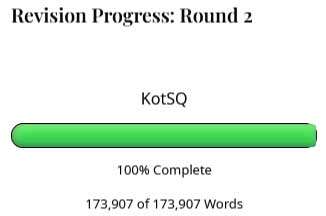
 *points at status bar* By the power of drudgery, I have half-assed my way to 100% of Revision Round 2!
*listless confetti*
This number is meaningless, but in the interest of trivia, the final word count of this draft is 182,214. Up more than 8K from the previous draft, but at least half of that has to be all-caps notes for Future Me. The trick will be controlling sprawl in the next draft, when I have to put meat on what are currently bare bones. Expanding on ideas requires more words, but (in theory) if the expansive words are done well, superfluous bare bones can be removed to balance the scales.
Still eyeballing 175K as the dreamiest final word count, but since that was a “no reasons, only vibes” choice, it’s less a mandate and more a warning to be ruthless about what really belongs in this book.
Shout out to Past Me for assigning one scene a tag of #VoidBoogaloo. I needed the laugh.
Struck a fair bit of irrelevant “color.” Item was the size of a certain kind of door in a place we haven’t been and aren’t going to go. Yes, a character familiar with such a thing might make such a mental comparison in “real life,” but it doesn’t mean anything to the reader. Effective storytelling requires building connections. Rattling off a bunch of random shit and blaming it on “worldbuilding” isn’t effective storytelling.
(Note to self: When documenting the descriptive endeavors you’re about to undertake, include retconning objects to be comparable. If it doesn’t matter whether Memorable Object in Chapter 5 looks a certain way, make it look a way that’s significant in comparison to Significant Object in Chapter 25. Even hair-fine threads that run from beginning to end contribute to resonance.)
Discovered a flaw in the “she can take part of the prop she can’t possess for plot reasons” development I was so excited about a few updates back. My heart is set on that development for series reasons, so I had to work it out. The solution was to make the evil prop 25% more evil, which will require half a page of discovery in a previous scene to set up.
Made notes about fixing the final boss fight. As it stands, Mentor Villain seems aware that she’s present only to be disposed of and climbs into a monster’s mouth while looking directly at the camera in open mockery of the hack writer. Okay, fine, she can figure something out before Heroine does and use it to her own advantage. And Heroine, who laughed at “she’s been like a mother to you” in an early chapter, did stay with this person of her own free will for 20 years and should have more complicated feelings about the showdown than “this is the bad guy I have to kill.”
Future Me is going to be pissed, but Present Me is doing the best she can with limited resources.
Did some copyediting housekeeping. For example, “There were twice as many guards in the library this time” became “This time, the library held twice as many guards.” That’s unlikely to be the final version (the guards might be a better subject than the room), but it at least steps away from the clunky “there was.”
No, I’m not one of those people who insists that one never use a form of “to be” as a verb. Sometimes a thing genuinely isn’t doing anything more active than existing, so say it is and move on to something with more vigor! However, “there is,” in particular, makes an object of the subject, which should be done only with specific intent. “There is the guard” and “The guard is there” contain all the same words but have wildly different potential energy. Do you want the static location imposed on the active being or the active being imposed on the static location? Either might be the case, but you should know the difference and choose with intent.
First thing now is to shovel off my desk and find any paper notes relevant to this book. I can’t clean because my ADHD needs visible evidence that a project is in progress, but I can sort.
Next step is scanning those paper notes and the all-caps notes throughout the document to see if any can be addressed now. Any that can’t be addressed immediately will be copied to the next section of my revision notebook, along with any neglected notes from section 1 that are still relevant. I’ll check the cutting-room-floor file for any existing material that might address those notes and tack usable words approximately where they belong. Maybe I’ll mark where I think the chapter breaks go to see if they feel okay during reading.
I also want to play with Laban efforts. I’ve been categorizing major characters while I learn, but I need to pin that information to each scene and categorize minor characters with contrasts in mind. I’ll wait until I get into Round 3 to squeeze everybody’s on-page actions into alignment. (At least I’ll try for a few scenes. If this experiment proves itself to be a terrible idea, I won’t hesitate to throw it in the bin.)
Then another full read straight through. I don’t expect the prose to be satisfactory at this point, but does the story hold up now? Gaps? Flaws in logic? Setups that are never paid off? Payoffs that were never set up? Draggy sections? Too even a keel for prolonged stretches? Things easier to track over the course of a few hours of reading than over a year of plodding revision. More notes for the notebook to flesh out the big actions of Revision Round 3.
In parts that don’t need major work, I’ll probably start the prose-prettifying process just to keep my fingers in those words, but that’s not a priority in Round 3.
I like this in-between part. (a) It’s much easier to find flaws than to fix them. (b) I can see how far the story has come since the rough draft, which stops the remaining flaws from being discouraging. Just keep eating ’em one bite at a time, and eventually they’ll be gone!